 Back
BackGene Transfer in Bacteria and Archaea: Mechanisms and Applications
Study Guide - Smart Notes
 Tailored notes based on your materials, expanded with key definitions, examples, and context.
Gene Transfer in Bacteria and Archaea
Overview of Bacterial and Archaeal Genetics
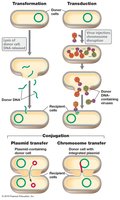
Bacteria and archaea possess unique mechanisms for exchanging genetic material, which contribute to their adaptability and evolution. These processes, collectively known as horizontal gene transfer (HGT), allow for the movement of genetic information between organisms, bypassing traditional parent-to-offspring inheritance. The three primary mechanisms of gene transfer are transformation, transduction, and conjugation.
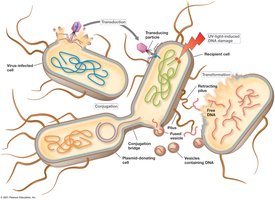
Mechanisms of Gene Transfer
Transformation
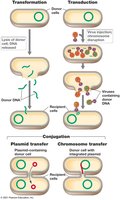
Transformation is the process by which bacteria take up free DNA from their environment. This DNA may originate from lysed cells and can integrate into the recipient's genome through homologous recombination, potentially conferring new traits such as antibiotic resistance.
Key Steps:
Uptake of free DNA by a competent bacterial cell
Integration of the DNA into the host genome via recombination
Example: A non-resistant bacterial cell acquires a DNA fragment carrying an antibiotic resistance gene, becoming resistant after successful transformation.
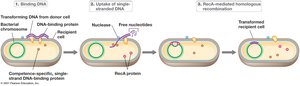
Additional info: Not all bacteria are naturally competent; some require specific conditions or treatments to become capable of DNA uptake.
Vibrio Pilus and DNA Uptake
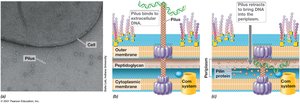
The Vibrio pilus is a specialized structure that facilitates the uptake of extracellular DNA during transformation. The pilus binds to DNA and retracts, bringing the DNA into the periplasmic space, where it can be processed and integrated.
Transduction
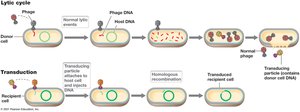
Transduction is the transfer of bacterial genes by bacteriophages (viruses that infect bacteria). There are two main types: generalized and specialized transduction. In generalized transduction, any bacterial gene can be transferred, while specialized transduction involves the transfer of specific genes near the phage integration site.
Generalized Transduction: Occurs when a phage accidentally packages host DNA instead of its own during assembly, transferring it to a new host upon infection.
Example: A phage infects a donor cell, incorporates fragments of bacterial DNA, and then injects this DNA into a recipient cell, where it may recombine with the recipient's genome.
Conjugation
Conjugation is the direct transfer of DNA from one bacterial cell (the donor) to another (the recipient) via cell-to-cell contact, typically mediated by a pilus. This process often involves plasmids, such as the F (fertility) plasmid in Escherichia coli, which carry genes for pilus formation and DNA transfer.
Key Steps:
Formation of a conjugation bridge (pilus) between donor and recipient
Transfer of plasmid or chromosomal DNA
Recipient cell acquires new genetic traits, such as antibiotic resistance
Example: Transfer of an R plasmid (resistance plasmid) from a resistant to a susceptible cell, conferring antibiotic resistance.
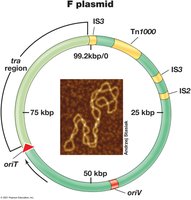
F (Fertility) Plasmid of Escherichia coli
The F plasmid is a circular DNA molecule that encodes genes necessary for conjugation, including those for pilus formation and DNA transfer. It can exist independently or integrate into the bacterial chromosome, forming an Hfr (high-frequency recombination) cell.
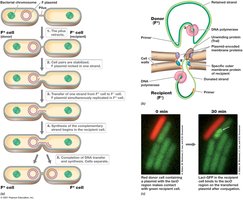
Transfer of Plasmid DNA by Conjugation
During conjugation, the F plasmid is nicked at the origin of transfer (oriT), and a single strand is transferred to the recipient cell. Both cells then synthesize the complementary strand, resulting in two F+ cells capable of further conjugation.
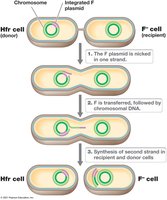
Transfer of Chromosomal DNA by Conjugation
When the F plasmid integrates into the host chromosome, the cell becomes an Hfr cell. During conjugation, chromosomal genes adjacent to the integrated F plasmid can be transferred to the recipient, allowing for mapping of bacterial genes.
Summary Table: Processes of DNA Transfer in Bacteria
Process | Mechanism | Genetic Material Transferred | Key Features |
|---|---|---|---|
Transformation | Uptake of free DNA from environment | Any DNA fragment | Requires competence; can confer new traits |
Transduction | Phage-mediated transfer | Any gene (generalized); specific genes (specialized) | Involves bacteriophages; accidental packaging of host DNA |
Conjugation | Direct cell-to-cell contact via pilus | Plasmid or chromosomal DNA | Requires conjugative plasmid; can transfer large DNA segments |
Applications and Importance
Antibiotic Resistance: Horizontal gene transfer is a major driver of the spread of antibiotic resistance among pathogenic bacteria.
Genetic Engineering: Understanding these mechanisms enables the development of molecular tools for gene cloning and biotechnology.
Microbial Evolution: HGT contributes to genetic diversity and rapid adaptation in microbial populations.
Additional info: These processes are central to microbial genetics and are foundational for advanced studies in molecular biology, biotechnology, and infectious disease research.
