Skip to main content
Microeconomics
My Course
Learn
Exam Prep
AI Tutor
Study Guides
Flashcards
Explore
Try the app
My Course
Learn
Exam Prep
AI Tutor
Study Guides
Flashcards
Explore
Try the app
Back
Advertising definitions
You can tap to flip the card.
Monopolistic Competition
You can tap to flip the card.
👆
Monopolistic Competition
Market structure where firms offer differentiated products and compete through advertising and branding.
Track progress
Control buttons has been changed to "navigation" mode.
1/15
Related flashcards
Related practice
Recommended videos
Advertising quiz #1
Advertising
10 Terms
Advertising
13. Monopolistic Competition
10 problems
Topic
Four Market Model Summary: Monopolistic Competition
13. Monopolistic Competition
10 problems
Topic
13. Monopolistic Competition
7 topics
15 problems
Chapter
Guided course
04:52
The Role of Advertising
1379
views
18
rank
Terms in this set (15)
Hide definitions
Monopolistic Competition
Market structure where firms offer differentiated products and compete through advertising and branding.
Product Differentiation
Strategy where firms highlight unique features to distinguish their offerings from competitors.
Demand Creation
Process by which firms stimulate consumer interest and desire for their products through marketing efforts.
Psychological Approach
Advertising tactic that appeals to emotions or perceptions rather than providing factual information.
Informational Approach
Advertising method focused on delivering factual details such as price, location, or product features.
Brand Name
Distinctive label that identifies a product and signals expected quality to consumers.
Quality Expectation
Consumer belief about the standard of a product based on its branding and advertising presence.
Reputation
Perceived standing of a firm or product, often maintained through consistent quality and branding.
Consumer Loyalty
Tendency of buyers to repeatedly choose a specific brand due to satisfaction and trust.
Signal
Indirect message conveyed to consumers, such as perceived quality, through advertising or branding.
Advertising Expenditure
Amount of resources allocated by firms to promote their products and influence consumer perceptions.
Critics
Individuals or groups who question the effectiveness or ethics of advertising practices.
Location Information
Details provided in advertisements to inform customers where products can be purchased.
New Product Introduction
Announcement in advertising that informs consumers about recently launched offerings.
Brand Differentiation
Process by which firms use names and marketing to make their products stand out in the market.
 BackBack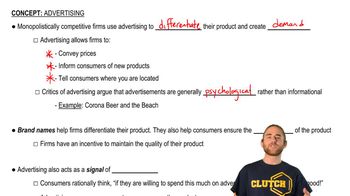
 04:52
04:52