Skip to main content
Microeconomics
My Course
Learn
Exam Prep
AI Tutor
Study Guides
Flashcards
Explore
Try the app
My Course
Learn
Exam Prep
AI Tutor
Study Guides
Flashcards
Explore
Try the app
Back
Bilateral Monopoly definitions
You can tap to flip the card.
Bilateral Monopoly
You can tap to flip the card.
👆
Bilateral Monopoly
A market structure featuring a single buyer and a single seller, resulting in intense negotiation and uncertain outcomes.
Track progress
Control buttons has been changed to "navigation" mode.
1/15
Related flashcards
Related practice
Recommended videos
Bilateral Monopoly quiz
Bilateral Monopoly
15 Terms
Bilateral Monopoly
15. Markets for the Factors of Production
10 problems
Topic
Monopsony
15. Markets for the Factors of Production
10 problems
Topic
15. Markets for the Factors of Production
10 topics
13 problems
Chapter
Guided course
05:32
Bilateral Monopoly
1057
views
1
rank
Terms in this set (15)
Hide definitions
Bilateral Monopoly
A market structure featuring a single buyer and a single seller, resulting in intense negotiation and uncertain outcomes.
Monopsony
A market condition where only one buyer exists, often seeking to pay below average prices for goods or services.
Labor Union
An organized group representing workers, pooling resources to negotiate collectively for higher wages and better conditions.
Employers Alliance
A coalition of employers acting as a unified buyer, often negotiating collectively with a labor union.
Negotiation Process
The series of discussions and bargaining between two parties, determining wage and quantity outcomes in a bilateral monopoly.
Negotiating Power
The relative strength each party holds in bargaining, influencing the final wage and equilibrium in a bilateral monopoly.
Competitive Wage
A pay rate that would be achieved in a market with balanced negotiating power, often considered a fair outcome.
Equilibrium Quantity
The amount of labor or goods agreed upon by both parties, determined through negotiation rather than market forces.
High Wage
A pay level sought by labor unions, typically above the market average, reflecting their bargaining objectives.
Low Wage
A pay level targeted by monopsonies, usually below the market average, reflecting their cost-saving goals.
Market Structure
The organizational characteristics of a market, such as the number of buyers and sellers, affecting negotiation dynamics.
Unionized Labor
Workforce represented collectively by a labor union, often the sole seller in a bilateral monopoly.
Unknown Outcome
A result in bilateral monopoly negotiations where wage and quantity cannot be predicted due to bargaining complexities.
Monopoly Power
The leverage held by a single market participant, diminished in bilateral monopoly due to mutual dependence.
Competitive Results
Outcomes resembling those in a balanced market, often achieved when negotiating power is equal in a bilateral monopoly.
 BackBack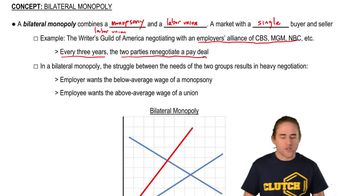
 05:32
05:32