A bilateral monopoly is a market with only one buyer and one seller, such as a labor union negotiating with a monopsony.
Who are the typical parties in a bilateral monopoly in the labor market?
The typical parties are a labor union (the sole seller of labor) and a monopsony employer or alliance (the sole buyer of labor).
What real-world example illustrates a bilateral monopoly?
The Writers Guild of America negotiating with an employers' alliance for TV show writers is a real-world example.
Why are negotiations in a bilateral monopoly often intense?
Negotiations are intense because both sides have significant power and opposing goals: the union wants higher wages, while the monopsony wants lower wages.
What determines the outcome (wage and quantity) in a bilateral monopoly?
The outcome is determined by the negotiation process and the relative bargaining power of each party, making the result uncertain.
What wage does the labor union typically fight for in a bilateral monopoly?
The labor union fights for a higher wage, above the competitive market wage.
What wage does the monopsony typically aim for in a bilateral monopoly?
The monopsony aims for a lower wage, below the competitive market wage.
Where does the final wage in a bilateral monopoly usually end up?
The final wage usually ends up somewhere between the high wage sought by the union and the low wage sought by the monopsony.
How does equal negotiating power affect the outcome in a bilateral monopoly?
If negotiating power is roughly equal, the outcome may be close to the competitive wage and quantity.
Why is the outcome of a bilateral monopoly considered uncertain?
Because it depends on the negotiation process and the relative power of each side, making the wage and quantity unpredictable.
How does a bilateral monopoly compare to a pure monopsony or monopoly in terms of outcomes?
A bilateral monopoly tends to produce more competitive and desirable outcomes than if only one side (monopsony or monopoly) had all the power.
What happens to monopoly power in a bilateral monopoly?
The monopoly powers of both sides tend to cancel each other out, leading to more competitive results.
Why do both parties in a bilateral monopoly need each other?
Because there is only one buyer and one seller, each party relies on the other to make a transaction.
What is the main focus in the analysis of a bilateral monopoly?
The main focus is the negotiation process between the single buyer and single seller.
How often do the Writers Guild of America and the employers' alliance renegotiate their pay deal?
They renegotiate their pay deal every three years.
 Back
Back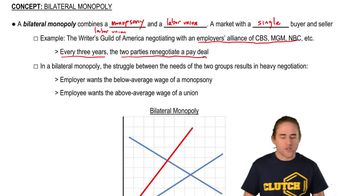
 05:32
05:32