Skip to main content
Microeconomics
My Course
Learn
Exam Prep
AI Tutor
Study Guides
Flashcards
Explore
Try the app
My Course
Learn
Exam Prep
AI Tutor
Study Guides
Flashcards
Explore
Try the app
Back
Condorcet Voting Paradox definitions
You can tap to flip the card.
Condorcet Voting Paradox
You can tap to flip the card.
👆
Condorcet Voting Paradox
A situation where majority voting among three or more options leads to a cycle of winners, causing inconsistent outcomes.
Track progress
Control buttons has been changed to "navigation" mode.
1/15
Related flashcards
Related practice
Recommended videos
Condorcet Voting Paradox quiz
Condorcet Voting Paradox
15 Terms
Condorcet Voting Paradox
17. Asymmetric Information, Voting, and Public Choice
10 problems
Topic
Median Voter Theorem
17. Asymmetric Information, Voting, and Public Choice
9 problems
Topic
17. Asymmetric Information, Voting, and Public Choice
4 topics
15 problems
Chapter
Guided course
03:39
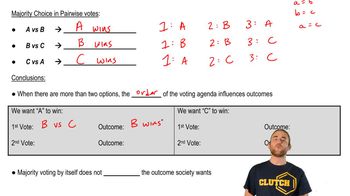
Condorcet Voting Paradox
906
views
2
rank
Guided course
02:33
Order of the Vote
695
views
1
rank
Terms in this set (15)
Hide definitions
Condorcet Voting Paradox
A situation where majority voting among three or more options leads to a cycle of winners, causing inconsistent outcomes.
Majority Voting
A decision process where the option with the most votes wins, but can result in paradoxical or manipulated outcomes.
Preference Order
The ranking of choices by individuals or groups, which determines their voting behavior in pairwise comparisons.
Non-Transitive Cycle
A sequence where option A beats B, B beats C, but C beats A, violating logical consistency in voting results.
Voting Agenda
The sequence in which options are paired and voted on, significantly affecting the final outcome.
Policy Manipulation
The strategic arrangement of voting order to ensure a desired option wins, regardless of overall preferences.
Pairwise Comparison
A method where two options are voted against each other, revealing group preferences and influencing results.
Group Preference
The collective ranking of choices by a subgroup, which shapes their voting decisions in each round.
Elimination Process
The removal of options through sequential votes, narrowing choices and impacting which policy prevails.
Policy Outcome
The final decision or winning option resulting from the voting process, often shaped by agenda manipulation.
Transitive Property
A logical principle where if A beats B and B beats C, then A should beat C, but fails in the paradox scenario.
Voting Sequence
The order in which votes are conducted, which can be exploited to favor certain outcomes.
Inconsistent Results
Outcomes where majority voting does not yield a clear winner, leading to cycles or contradictions.
Policyholder
An individual or group with the power to set the voting agenda, potentially influencing the final decision.
Societal Outcome
The result of collective voting, which may not reflect the true preferences of the majority due to manipulation.
 BackBack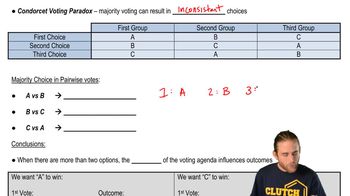
 03:39
03:39