Skip to main content
Microeconomics
My Course
Learn
Exam Prep
AI Tutor
Study Guides
Flashcards
Explore
Try the app
My Course
Learn
Exam Prep
AI Tutor
Study Guides
Flashcards
Explore
Try the app
Back
Demand-Pull and Cost-Push Inflation definitions
You can tap to flip the card.
Inflation
You can tap to flip the card.
👆
Inflation
A sustained rise in overall price levels, often resulting from shifts in demand or supply that disrupt market equilibrium.
Track progress
Control buttons has been changed to "navigation" mode.
1/15
Related flashcards
Recommended videos
Demand-Pull and Cost-Push Inflation quiz
Demand-Pull and Cost-Push Inflation
15 Terms
Guided course
02:22
Cost-Push Inflation
4
views
Guided course
03:53
Demand-Pull Inflation
4
views
Terms in this set (15)
Hide definitions
Inflation
A sustained rise in overall price levels, often resulting from shifts in demand or supply that disrupt market equilibrium.
Demand-Pull Inflation
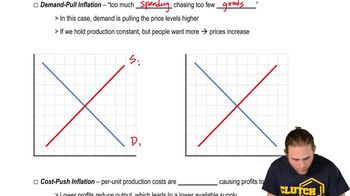
A price increase caused by excessive demand that cannot be matched by available supply, leading to higher equilibrium prices.
Cost-Push Inflation
A price increase resulting from rising production costs, which reduce supply and elevate market prices.
Supply Shock
An unexpected event that alters production costs or availability, causing a sudden shift in the supply curve.
Equilibrium Price
The market price where quantity demanded equals quantity supplied, often altered by inflationary pressures.
Quantity Supplied
The amount of goods producers are willing to offer at a specific price, which may remain constant during demand-pull inflation.
Market Equilibrium
A state where supply and demand intersect, determining price and quantity; disrupted during inflationary episodes.
Production Costs
Expenses incurred by firms to create goods, which, when rising, can trigger cost-push inflation.
Scarcity
A condition where available resources or goods are insufficient to meet demand, intensifying inflationary effects.
Profit
The financial gain from selling goods after covering production costs, often reduced during cost-push inflation.
Supply Curve
A graphical representation showing the relationship between price and quantity supplied, shifting left during supply shocks.
Demand Curve
A graph illustrating how quantity demanded varies with price, shifting right during demand-pull inflation.
Price Level
The average of current prices across the economy, which rises during both demand-pull and cost-push inflation.
Output
The total quantity of goods produced, which may decrease during cost-push inflation due to reduced supply.
Macroeconomics
The branch of economics focusing on broad phenomena like inflation, supply shocks, and overall price levels.
 BackBack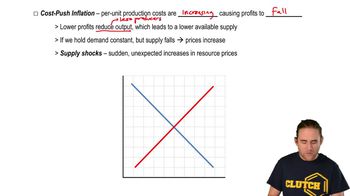
 02:22
02:22