Skip to main content
Microeconomics
My Course
Learn
Exam Prep
AI Tutor
Study Guides
Flashcards
Explore
Try the app
My Course
Learn
Exam Prep
AI Tutor
Study Guides
Flashcards
Explore
Try the app
Back
Demand-Pull and Cost-Push Inflation quiz
You can tap to flip the card.
What is demand-pull inflation?
You can tap to flip the card.
👆
What is demand-pull inflation?
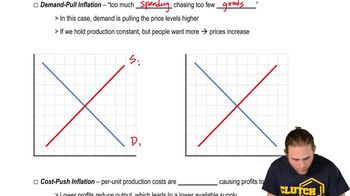
Demand-pull inflation occurs when increased demand outpaces supply, causing prices to rise even though the quantity supplied remains constant.
Track progress
Control buttons has been changed to "navigation" mode.
1/15
Related flashcards
Recommended videos
Demand-Pull and Cost-Push Inflation definitions
Demand-Pull and Cost-Push Inflation
15 Terms
Guided course
02:22
Cost-Push Inflation
4
views
Guided course
03:53
Demand-Pull Inflation
4
views
Terms in this set (15)
Hide definitions
What is demand-pull inflation?
Demand-pull inflation occurs when increased demand outpaces supply, causing prices to rise even though the quantity supplied remains constant.
What happens to equilibrium price during demand-pull inflation?
The equilibrium price increases because demand rises but supply cannot match it, leading to higher prices.
Why does quantity supplied not increase during demand-pull inflation?
Quantity supplied remains constant because production cannot be increased to meet the higher demand.
What is the main cause of cost-push inflation?
Cost-push inflation is caused by rising production costs, which reduce supply and push prices upward.
How does a supply shock relate to cost-push inflation?
A supply shock occurs when unexpected increases in production costs reduce supply, leading to cost-push inflation.
What happens to equilibrium quantity during cost-push inflation?
Equilibrium quantity decreases because higher production costs cause firms to reduce output.
How do profits change for firms during cost-push inflation?
Profits fall as per unit production costs rise, leading some firms to leave the industry and reduce supply.
What is the effect of demand-pull inflation on price and quantity if supply is constant?
Prices rise while the quantity supplied remains unchanged, as demand increases but supply cannot respond.
How does the supply curve shift during cost-push inflation?
The supply curve shifts to the left, indicating a decrease in supply due to higher production costs.
What is meant by 'too much spending chasing too few goods'?
It describes demand-pull inflation, where excessive demand cannot be met by available supply, causing prices to rise.
What is the difference between demand-pull and cost-push inflation?
Demand-pull inflation is caused by increased demand, while cost-push inflation is caused by increased production costs reducing supply.
What happens to the market equilibrium during demand-pull inflation?
The equilibrium price rises, but the equilibrium quantity does not increase because supply is fixed.
What is the role of scarcity in demand-pull inflation?
Scarcity means supply cannot meet increased demand, resulting in higher prices without increased output.
How does cost-push inflation affect the number of producers in the market?
Higher costs and lower profits cause some producers to exit the market, reducing overall supply.
Why do prices rise in both demand-pull and cost-push inflation?
In both cases, prices rise because either demand increases or supply decreases, shifting the market equilibrium upward.
 BackBack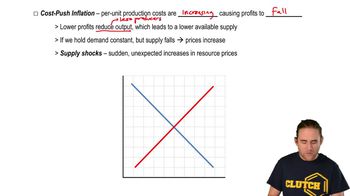
 02:22
02:22