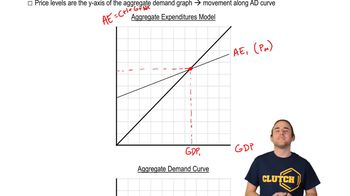
What components make up aggregate expenditures in the aggregate expenditure model?
Aggregate expenditures consist of consumption, investment, government spending, and net exports.
How does a higher price level affect aggregate expenditures and GDP?
A higher price level reduces aggregate expenditures and GDP due to decreased consumption, investment, and net exports.
What is the relationship between price level and aggregate demand according to the aggregate expenditure model?
As price level increases, aggregate demand decreases, forming a downward-sloping aggregate demand curve.
Which effects explain why higher prices reduce consumption, investment, and net exports?
The wealth effect, interest rate effect, and exchange rate effect explain the reduction in these components at higher prices.
What happens to equilibrium GDP when prices in the economy are low?
Equilibrium GDP increases because lower prices boost consumption, investment, and net exports.
How is the aggregate demand curve derived from the aggregate expenditure model?
By plotting equilibrium GDP at different price levels, the aggregate demand curve is formed, showing GDP demanded at each price.
What does holding price levels constant and increasing investment spending do to the aggregate demand curve?
It shifts the aggregate demand curve to the right, increasing GDP demanded at the same price level.
What is the multiplier effect in the context of aggregate expenditures?
The multiplier effect refers to how an increase in one component, like investment, leads to a larger overall increase in aggregate expenditures and GDP.
What happens to aggregate expenditures when investment spending increases, holding price constant?
Aggregate expenditures increase, resulting in a higher equilibrium GDP at the same price level.
How does the aggregate expenditure model help us understand shifts in aggregate demand?
It shows that changes in spending components, independent of price, can shift the aggregate demand curve rightward or leftward.
What is the main difference between the aggregate expenditure curve and the aggregate demand curve?
The aggregate expenditure curve does not show price levels, while the aggregate demand curve plots GDP against price levels.
What happens to GDP demanded when the price level is high, according to the aggregate demand curve?
GDP demanded is lower at higher price levels due to reduced aggregate expenditures.
How do changes in determinants like investment affect the aggregate demand curve?
They shift the aggregate demand curve, increasing or decreasing GDP demanded at constant prices.
What is meant by macroeconomic equilibrium in the aggregate expenditure model?
Macroeconomic equilibrium occurs where aggregate expenditures equal GDP, representing balanced production and spending.
Why does the aggregate demand curve slope downward?
Because higher prices lead to lower aggregate expenditures and GDP, while lower prices increase them.
 Back
Back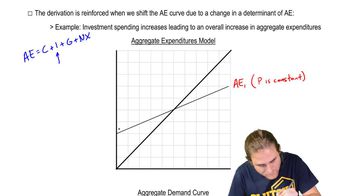
 04:13
04:13