What is an example of labor-market discrimination?
Labor-market discrimination occurs when employers pay lower wages or refuse to hire individuals based on irrelevant characteristics such as race or gender, rather than qualifications or job performance. For example, not hiring someone because of their race or paying women less than men for the same job are examples of labor-market discrimination.
Statistical discrimination occurs when employers judge applicants based on the average characteristics of the group to which the applicant belongs, rather than the individual's own qualifications.
Statistical discrimination happens when employers make decisions about applicants using group averages—such as education level or job experience of a demographic group—instead of evaluating each applicant's personal qualifications and abilities.
How does occupational segregation contribute to wage differences between men and women?
Occupational segregation means women are concentrated in low-paying jobs while men dominate high-paying jobs, leading to persistent wage gaps. This pattern is slowly changing as educational opportunities become more equal.
What is one way institutionalized discrimination affects African Americans' economic opportunities?
Institutionalized discrimination often results in inferior schooling in predominantly Black neighborhoods, which lowers human capital and limits job opportunities. This disadvantage is not a matter of personal choice but a systemic issue.
How do job interruptions impact women's wages compared to men's?
Job interruptions, such as those related to pregnancy and childcare, reduce women's work experience and human capital, leading to lower wages. Men generally experience fewer job interruptions, which helps maintain higher earnings.
What did studies about resume callbacks reveal about hiring discrimination?
Studies found that resumes with white-sounding names received more callbacks than those with Black-sounding names, indicating ongoing racial discrimination in hiring practices. This bias limits job access and experience for minorities.
Why do white males tend to have higher human capital compared to other groups?
Historically, white males have had greater access to higher education and fewer job interruptions, resulting in higher human capital. This advantage contributes to their higher average wages.
How can non-discriminatory businesses gain a competitive advantage over discriminatory ones?
Non-discriminatory businesses can hire from a larger pool of qualified candidates and pay lower wages, reducing their costs. This efficiency can help them outcompete and potentially drive discriminatory businesses out of the market.
What is meant by the term 'human capital' in the context of wage differences?
Human capital refers to the skills, education, and experience that increase a worker's productivity and earning potential. Differences in human capital, often shaped by education and job experience, help explain wage disparities.
How do historical trends in education affect current wage disparities?
Past limitations in educational opportunities for women and minorities mean that current wage disparities persist, even as more of these groups now attend college. It takes time for these changes to fully impact wage equality.
 Back
Back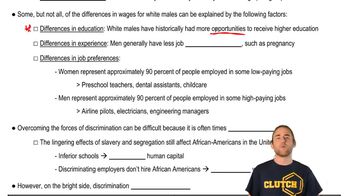
 06:59
06:59