Skip to main content
Microeconomics
My Course
Learn
Exam Prep
AI Tutor
Study Guides
Flashcards
Explore
Try the app
My Course
Learn
Exam Prep
AI Tutor
Study Guides
Flashcards
Explore
Try the app
Back
Monopoly Efficiency and Deadweight Loss definitions
You can tap to flip the card.
Monopoly
You can tap to flip the card.
👆
Monopoly
A single seller controls the market, restricts output, and sets a higher price than in competitive markets.
Track progress
Control buttons has been changed to "navigation" mode.
1/15
Related flashcards
Related practice
Recommended videos
Monopoly Efficiency and Deadweight Loss quiz #1
Monopoly Efficiency and Deadweight Loss
10 Terms
Monopoly Efficiency and Deadweight Loss
12. Monopoly
8 problems
Topic
Price Discrimination
12. Monopoly
10 problems
Topic
12. Monopoly
9 topics
13 problems
Chapter
Guided course
12:19
Monopoly Efficiency and Deadweight Loss
3071
views
22
rank
Terms in this set (15)
Hide definitions
Monopoly
A single seller controls the market, restricts output, and sets a higher price than in competitive markets.
Perfect Competition
A market structure where many sellers offer identical products, resulting in efficient output and pricing.
Consumer Surplus
The difference between what buyers are willing to pay and what they actually pay, represented by areas above price and below demand.
Producer Surplus
The difference between the price sellers receive and their minimum acceptable price, shown below price and above supply.
Deadweight Loss
Lost economic surplus from trades that do not occur due to restricted output, illustrated by missing areas on the graph.
Economic Surplus
The total benefit to society from market transactions, combining consumer and producer surplus.
Productive Efficiency
Achieved when production occurs at the lowest possible cost, at the minimum of the average total cost curve.
Allocative Efficiency
Occurs when production matches consumer preferences, with marginal benefit equaling marginal cost.
Marginal Cost
The additional expense incurred from producing one more unit, represented by the supply curve in competition.
Marginal Revenue
The extra income received from selling one more unit, guiding output decisions in monopoly.
Average Total Cost
The total cost per unit, with its minimum indicating the most efficient production point.
Market Power
The ability of a seller to influence price and output, characteristic of monopoly.
Equilibrium Price
The market price where supply equals demand, resulting in efficient allocation in competition.
Efficient Quantity
The output level where total surplus is maximized, with no deadweight loss present.
Supply Curve
A graphical representation of the relationship between price and quantity offered by sellers, often aligned with marginal cost.
 BackBack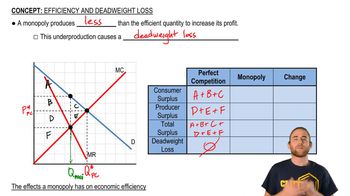
 12:19
12:19