Elasticity and the Midpoint Method quiz #1 Flashcards

Elasticity and the Midpoint Method quiz #1
Control buttons has been changed to "navigation" mode.
1/10
  • Refer to the table of prices and quantities. Using the midpoint method, how do you calculate the price elasticity of demand?
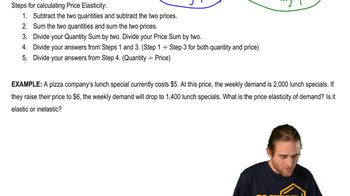
    To calculate price elasticity of demand using the midpoint method, follow these steps: 1) Subtract the initial and final quantities and prices to find the changes. 2) Add the initial and final quantities and prices, then divide each sum by 2 to find the averages. 3) Divide the change in quantity by the average quantity to get the percentage change in quantity demanded. 4) Divide the change in price by the average price to get the percentage change in price. 5) Divide the percentage change in quantity demanded by the percentage change in price. This gives the price elasticity of demand.
  • Why does the midpoint method provide consistent elasticity results regardless of whether price increases or decreases?
    The midpoint method uses the average of initial and final values for both price and quantity, eliminating the bias that occurs when using only the original value as the denominator.
  • What is the denominator used in the percentage change calculation for the midpoint method?
    The denominator is the average of the initial and final values, calculated by adding them together and dividing by two.
  • In the pizza company example, what was the percentage change in quantity demanded when the price increased from $5 to $6?
    The percentage change in quantity demanded was 35.3%.
  • What does an elasticity of demand greater than 1 indicate about the demand for a product?
    An elasticity greater than 1 means demand is elastic, so quantity demanded is highly responsive to price changes.
  • What is the first step in calculating elasticity using the midpoint method?
    The first step is to subtract the initial and final quantities and prices to find the changes.
  • How do you find the average price when using the midpoint method?
    Add the initial and final prices together and divide by two.
  • What is the formula for price elasticity of demand using the midpoint method?
    It is the percentage change in quantity demanded divided by the percentage change in price, with both changes calculated using averages.
  • Why is it recommended to use positive numbers when subtracting quantities and prices in the midpoint method?
    Using positive numbers simplifies calculations and avoids confusion, as the direction of change does not affect the final elasticity value.
  • What is the final step after calculating percentage changes in quantity and price using the midpoint method?
    Divide the percentage change in quantity demanded by the percentage change in price to find the price elasticity of demand.