Skip to main content
Microeconomics
My Course
Learn
Exam Prep
AI Tutor
Study Guides
Flashcards
Explore
Try the app
My Course
Learn
Exam Prep
AI Tutor
Study Guides
Flashcards
Explore
Try the app
Back
Four Market Model Summary: Monopoly definitions
You can tap to flip the card.
Monopoly
You can tap to flip the card.
👆
Monopoly
A market structure with only one producer supplying a unique product, often due to high entry barriers.
Track progress
Control buttons has been changed to "navigation" mode.
1/15
Related flashcards
Related practice
Recommended videos
Four Market Model Summary: Monopoly quiz
Four Market Model Summary: Monopoly
15 Terms
Four Market Model Summary: Monopoly
12. Monopoly
10 problems
Topic
Four Firm Concentration Ratio
12. Monopoly
10 problems
Topic
12. Monopoly
9 topics
13 problems
Chapter
Guided course
04:34
Four Market Model Summary: Monopoly
1669
views
11
rank
Terms in this set (15)
Hide definitions
Monopoly
A market structure with only one producer supplying a unique product, often due to high entry barriers.
Supplier
The entity responsible for providing goods or services in a market, often the sole provider in this structure.
Utilities
Industries such as electricity or water, typically operated by a single firm due to cost advantages.
Patent
A government-granted protection allowing exclusive production rights for a specific product, like a drug.
Barriers to Entry
Obstacles preventing new firms from entering a market, including resource ownership, government protection, or economies of scale.
Natural Monopoly
A situation where a single firm can supply the entire market more efficiently due to large-scale cost advantages.
Economies of Scale
Cost advantages gained when production increases, making it cheaper for one firm to serve the whole market.
Market Power
The ability to control market prices and quantities, often resulting from being the sole provider.
Marginal Revenue
The additional income received from selling one more unit, always below price in this market structure.
Marginal Cost
The extra expense incurred from producing one additional unit, used to determine profit-maximizing output.
Profit Maximizing Quantity
The output level where additional revenue equals additional cost, ensuring maximum possible profit.
Long Run Profitability
The potential for sustained earnings over time due to limited competition and high entry barriers.
Demand Curve
A graphical representation showing how price relates to quantity demanded, always above marginal revenue here.
Average Revenue
The revenue earned per unit sold, equal to price in all market structures.
Market Structure
The organizational characteristics of a market, such as number of firms and entry barriers, used for comparison.
 BackBack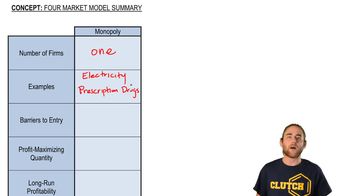
 04:34
04:34