How many suppliers are there in a monopoly market structure?
There is only one supplier in a monopoly market structure.
What is a common example of a natural monopoly?
Utilities, such as electricity companies, are common examples of natural monopolies.
Why do electricity companies often operate as monopolies?
Electricity companies often operate as monopolies due to economies of scale, making it inefficient for multiple firms to serve the same area.
How do patents contribute to monopoly power in the prescription drug industry?
Patents grant exclusive production rights to a company for a set period, limiting competition and giving the company monopoly power over the drug.
What is the main incentive for companies to research and develop new drugs under a monopoly?
The main incentive is the protection provided by patents, which allows companies to profit exclusively from their research.
What are the barriers to entry like in a monopoly?
Barriers to entry in a monopoly are high, making it difficult for new firms to enter the market.
List three sources of barriers to entry in a monopoly.
Barriers can come from ownership of key resources, government protection (like patents), or natural monopolies due to economies of scale.
At what point does a monopoly maximize its profit?
A monopoly maximizes profit where marginal revenue equals marginal cost.
Can monopolies earn long-run profits? Why or why not?
Yes, monopolies can earn long-run profits because high barriers to entry prevent new competitors from entering the market.
How does the relationship between price and marginal revenue in a monopoly differ from perfect competition?
In a monopoly, price is greater than marginal revenue, whereas in perfect competition, price equals marginal revenue.
Why is the marginal revenue curve below the demand curve in a monopoly?
The marginal revenue curve is below the demand curve because the monopoly faces a downward-sloping demand, so it must lower the price to sell more units.
How does the price set by a monopoly compare to its marginal cost?
The price set by a monopoly is above its marginal cost.
Where do monopoly profits come from in terms of price and cost?
Monopoly profits come from setting the price above both marginal revenue and marginal cost.
What is a key difference between monopolies and perfectly competitive markets regarding entry barriers?
Monopolies have high barriers to entry, while perfectly competitive markets have no significant barriers.
Why is it important to compare and contrast different market structures like monopoly?
Comparing market structures helps understand how different conditions affect pricing, output, and profitability in various industries.
 Back
Back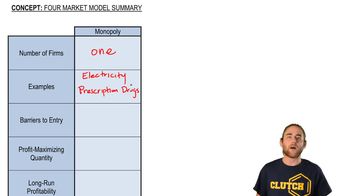
 04:34
04:34