Skip to main content
Microeconomics
My Course
Learn
Exam Prep
AI Tutor
Study Guides
Flashcards
Explore
Try the app
My Course
Learn
Exam Prep
AI Tutor
Study Guides
Flashcards
Explore
Try the app
Back
Income Equality and Efficiency definitions
You can tap to flip the card.
Income Equality
You can tap to flip the card.
👆
Income Equality
A situation where all individuals receive the same amount of income, regardless of their effort or contribution.
Track progress
Control buttons has been changed to "navigation" mode.
1/15
Related flashcards
Related practice
Recommended videos
Income Equality and Efficiency quiz
Income Equality and Efficiency
15 Terms
Income Equality and Efficiency
16. Income Inequality and Poverty
10 problems
Topic
Lorenz Curve and Gini Coefficient
16. Income Inequality and Poverty
10 problems
Topic
16. Income Inequality and Poverty
5 topics
14 problems
Chapter
Guided course
06:41
Income Equality and Efficiency
904
views
2
rank
Terms in this set (15)
Hide definitions
Income Equality
A situation where all individuals receive the same amount of income, regardless of their effort or contribution.
Efficiency
The optimal allocation of resources that maximizes output or welfare without waste, often linked to incentives.
Utility
A numerical measure of satisfaction or happiness used in economic analysis to compare outcomes.
Marginal Utility
The extra satisfaction gained from consuming one additional unit, such as spending one more dollar.
Diminishing Returns
A principle where each additional unit consumed yields less satisfaction than the previous one.
Income Redistribution
A process where government collects and reallocates income to achieve greater equality among individuals.
Total Utility
The sum of satisfaction or happiness experienced by all individuals in a population.
Opportunity Cost
The value of the next best alternative forgone when a choice is made, such as efficiency lost for equality.
Equality-Efficiency Trade-Off
A balance between achieving equal income and maintaining incentives for productive effort.
Marginal Utility Curve
A graphical representation showing how additional satisfaction decreases as more units are consumed.
Incentive
A motivating factor that encourages individuals to work harder or be more productive.
Lost Utility
The reduction in satisfaction experienced when income is taken away from an individual.
Gained Utility
The increase in satisfaction experienced when an individual receives additional income.
Perfect Equality
A scenario where every person receives identical income, often resulting in maximum total satisfaction.
Revenue
The total amount of money collected, often by the government, for redistribution or other purposes.
 BackBack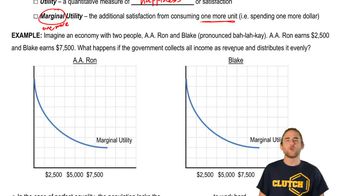
 06:41
06:41