Skip to main content
Microeconomics
My Course
Learn
Exam Prep
AI Tutor
Study Guides
Flashcards
Explore
Try the app
My Course
Learn
Exam Prep
AI Tutor
Study Guides
Flashcards
Explore
Try the app
Back
Income Equality and Efficiency quiz
You can tap to flip the card.
What is utility in economics?
You can tap to flip the card.
👆
What is utility in economics?
Utility is a quantitative measure of happiness or satisfaction that individuals receive from consuming goods or services.
Track progress
Control buttons has been changed to "navigation" mode.
1/15
Related flashcards
Related practice
Recommended videos
Income Equality and Efficiency definitions
Income Equality and Efficiency
15 Terms
Income Equality and Efficiency
16. Income Inequality and Poverty
10 problems
Topic
Lorenz Curve and Gini Coefficient
16. Income Inequality and Poverty
10 problems
Topic
16. Income Inequality and Poverty
5 topics
14 problems
Chapter
Guided course
06:41
Income Equality and Efficiency
904
views
2
rank
Terms in this set (15)
Hide definitions
What is utility in economics?
Utility is a quantitative measure of happiness or satisfaction that individuals receive from consuming goods or services.
How does marginal utility relate to income?
Marginal utility refers to the additional satisfaction gained from spending one more dollar, and it typically decreases as income increases.
What is meant by diminishing returns in the context of utility?
Diminishing returns means that each additional unit of income or consumption provides less additional utility than the previous unit.
How does perfect income equality affect total utility in a population?
Perfect income equality maximizes the total utility of the population because resources are distributed where they provide the most satisfaction.
What happens to incentives to work in a system of perfect equality?
In perfect equality, individuals have less incentive to work hard because everyone receives the same income regardless of effort.
Why does redistributing income from a richer person to a poorer person increase total utility?
Because the poorer person gains more utility from each additional dollar than the richer person loses, resulting in a net gain in total utility.
What is the opportunity cost of achieving greater income equality?
The opportunity cost of greater equality is reduced economic efficiency, as incentives to work and produce may decrease.
How does the marginal utility curve typically slope, and why?
The marginal utility curve is downward sloping because of diminishing returns; each extra dollar provides less satisfaction.
In the example with A. A. Ron and Balake, who gains more utility from income redistribution and why?
A. A. Ron gains more utility because he starts with less income, so each additional dollar increases his satisfaction more than it decreases Balake's.
What is the equality-efficiency trade-off?
The equality-efficiency trade-off is the idea that increasing equality can reduce efficiency, as it may lower incentives to work or innovate.
Why might a superstar gain less utility from buying a 13th car compared to someone buying their first car?
Because of diminishing marginal utility, the superstar already has many cars, so each additional car brings less satisfaction.
What does a downward-sloping marginal utility curve indicate about additional income?
It indicates that each additional dollar provides less utility than the previous one.
How does the government’s redistribution of income affect total utility in the example given?
Redistribution increases total utility because the gain in utility for the poorer individual exceeds the loss for the richer individual.
What is meant by 'quantifying' utility in economics?
Quantifying utility means assigning numerical values to levels of happiness or satisfaction to facilitate economic analysis.
What is the main drawback of perfect income equality according to the lesson?
The main drawback is the loss of efficiency due to reduced incentives for individuals to work hard or be productive.
 BackBack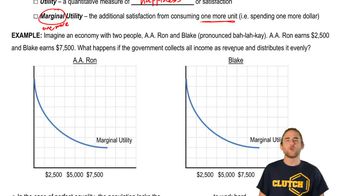
 06:41
06:41