Skip to main content
Microeconomics
My Course
Learn
Exam Prep
AI Tutor
Study Guides
Flashcards
Explore
Try the app
My Course
Learn
Exam Prep
AI Tutor
Study Guides
Flashcards
Explore
Try the app
Back
Isoquant Lines quiz
You can tap to flip the card.
What do isoquant lines represent in production analysis?
You can tap to flip the card.
👆
What do isoquant lines represent in production analysis?
Isoquant lines show all combinations of two inputs, like labor and capital, that produce the same level of output.
Track progress
Control buttons has been changed to "navigation" mode.
1/15
Related flashcards
Related practice
Recommended videos
Isoquant Lines definitions
Isoquant Lines
15 Terms
Isoquant Lines
10. The Costs of Production
10 problems
Topic
Isocost Lines
10. The Costs of Production
8 problems
Topic
10. The Costs of Production
9 topics
15 problems
Chapter
Guided course
09:45
Isoquant Lines
2132
views
24
rank
Terms in this set (15)
Hide definitions
What do isoquant lines represent in production analysis?
Isoquant lines show all combinations of two inputs, like labor and capital, that produce the same level of output.
How can a firm produce 500 cookies using different input bundles?
A firm can use combinations such as 1 oven with 9 bakers or 7 ovens with 1 baker to produce 500 cookies.
What does the axis of an isoquant graph typically represent?
One axis shows the quantity of ovens (capital) and the other shows the quantity of bakers (labor).
What is the Marginal Rate of Technical Substitution (MRTS)?
MRTS measures how much of one input must be given up to gain one unit of another input while keeping output constant.
How is MRTS calculated on an isoquant curve?
MRTS is calculated as the slope of the isoquant curve at a specific point, or the change in one input divided by the change in the other.
What happens to input requirements as production increases from 500 to 750 cookies?
More resources, either labor or ovens, are needed to produce a higher output like 750 cookies.
What does a point on an isoquant line indicate?
Each point represents a specific combination of inputs that yields the same level of output.
Why are isoquant lines curved rather than straight?
Isoquant lines are curved because the rate at which inputs can be substituted changes due to diminishing returns.
What is meant by 'diminishing returns' in the context of isoquants?
Diminishing returns occur when adding more of one input results in less efficient substitution for another input.
How does MRTS change as you move along an isoquant?
MRTS decreases as you substitute more of one input for another, reflecting diminishing returns.
What is the MRTS when substituting 3 ovens for 1 baker at high oven levels?
The MRTS is 3, meaning you can give up 3 ovens and hire 1 more baker to maintain the same output.
What is the MRTS when substituting 2 ovens for 2 bakers at moderate oven levels?
The MRTS is 1, so for each oven given up, one more baker must be hired to keep output constant.
What is the MRTS when substituting 1 oven for 5 bakers at low oven levels?
The MRTS is 1/5, meaning for each oven lost, 5 more bakers are needed to maintain production.
How can isoquant analysis help a firm?
Isoquant analysis helps determine the most cost-efficient combination of inputs for production.
How are isoquant lines similar to indifference curves in economics?
Both isoquant lines and indifference curves show combinations that yield the same level of output or satisfaction, respectively.
 BackBack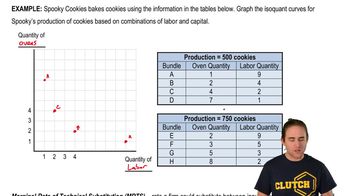
 09:45
09:45