Skip to main content
Microeconomics
My Course
Learn
Exam Prep
AI Tutor
Study Guides
Flashcards
Explore
Try the app
My Course
Learn
Exam Prep
AI Tutor
Study Guides
Flashcards
Explore
Try the app
Back
Monopsony definitions
You can tap to flip the card.
Monopsony
You can tap to flip the card.
👆
Monopsony
A market structure with a single buyer, often seen in labor markets, allowing control over wages and employment levels.
Track progress
Control buttons has been changed to "navigation" mode.
1/15
Related flashcards
Related practice
Recommended videos
Monopsony quiz #1
Monopsony
10 Terms
Monopsony
15. Markets for the Factors of Production
10 problems
Topic
Bilateral Monopoly
15. Markets for the Factors of Production
10 problems
Topic
15. Markets for the Factors of Production
10 topics
13 problems
Chapter
Guided course
07:18
Monopsony
1117
views
6
rank
Guided course
03:52
Monopsony and Minimum Wage
935
views
8
rank
Terms in this set (15)
Hide definitions
Monopsony
A market structure with a single buyer, often seen in labor markets, allowing control over wages and employment levels.
Labor Market
A setting where firms hire workers, with supply and demand determining wages and employment quantities.
Marginal Cost Curve
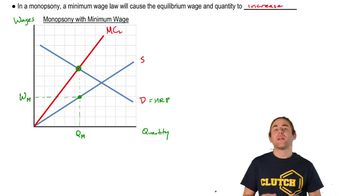
A graphical representation showing how the cost of hiring additional workers increases, especially in a monopsony.
Marginal Revenue Product
The additional value generated by hiring one more worker, forming the basis for a firm's demand for labor.
Equilibrium Wage
The wage rate at which labor supply equals labor demand, typically higher in competitive markets than in monopsonies.
Equilibrium Quantity
The number of workers employed where labor supply and demand intersect, often reduced in a monopsony.
Supply Curve
A graph showing the relationship between wage levels and the quantity of labor workers are willing to provide.
Demand Curve
A graph depicting how many workers a firm wants to hire at different wage levels, based on their productivity.
Minimum Wage Law
A regulation setting a wage floor, which can raise both wages and employment in a monopsony to competitive levels.
Competitive Market
A market with many buyers and sellers, where wages and employment are determined by supply and demand without single-firm influence.
Derived Demand
The demand for labor based on the value of goods and services produced by workers.
Profit Maximization
A firm's goal to hire workers up to the point where the cost of labor equals the value produced by that labor.
Wage Floor
The lowest legal wage that can be paid, often set by government intervention to protect workers.
Quantity Restriction
A reduction in the number of workers hired, resulting from monopsony power over the labor market.
Market Power
The ability of a firm to influence wages and employment levels due to its dominant position as the sole buyer.
 BackBack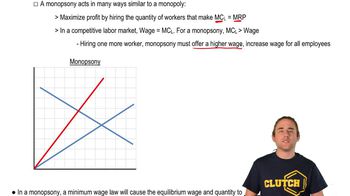
 07:18
07:18