Back

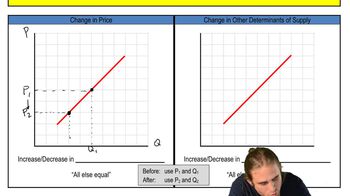
Movement Along a Supply Curve definitions

Control buttons has been changed to "navigation" mode.
1/14
  • Supply Curve

    A graphical representation showing the relationship between price and quantity supplied, holding other factors constant.
  • Quantity Supplied

    The amount of a good producers are willing to offer at a specific price, illustrated by a point on the supply curve.
  • Price

    The monetary value assigned to a good, serving as a variable on the supply curve's axis and affecting movement along the curve.
  • Movement Along the Supply Curve

    A change in the position on the existing supply curve caused solely by a change in price, not by other factors.
  • Shift of the Supply Curve

    A change in supply resulting in a new, parallel supply curve due to factors other than price.
  • Increase in Supply

    A rightward shift of the supply curve, indicating producers are willing to supply more at every price.
  • Decrease in Supply

    A leftward shift of the supply curve, showing producers are willing to supply less at every price.
  • Ceteris Paribus

    An analytical principle where all variables except one are held constant to isolate the effect of a single factor.
  • Determinants of Supply

    Factors other than price that can cause the supply curve to shift, such as technology or input costs.
  • Law of Supply

    A principle stating that, all else equal, higher prices lead to higher quantity supplied and lower prices lead to lower quantity supplied.
  • Parallel Shift

    A movement of the entire supply curve to the right or left, maintaining its original slope.
  • Axes

    The horizontal and vertical lines on a graph representing price and quantity, used to plot the supply curve.
  • Original Supply

    The initial supply curve before any shifts or movements occur, serving as a reference for changes.
  • New Supply

    A supply curve drawn after a shift, representing altered supply conditions due to changes in determinants.