Skip to main content
Microeconomics
My Course
Learn
Exam Prep
AI Tutor
Study Guides
Flashcards
Explore
Try the app
My Course
Learn
Exam Prep
AI Tutor
Study Guides
Flashcards
Explore
Try the app
Back
New Growth Theory definitions
You can tap to flip the card.
New Growth Theory
You can tap to flip the card.
👆
New Growth Theory
A framework highlighting technology and knowledge as central to sustained economic expansion, emphasizing increasing returns and public benefits.
Track progress
Control buttons has been changed to "navigation" mode.
1/15
Related flashcards
Recommended videos
New Growth Theory quiz
New Growth Theory
15 Terms
Guided course
06:15
New Growth Theory
5
views
Terms in this set (15)
Hide definitions
New Growth Theory
A framework highlighting technology and knowledge as central to sustained economic expansion, emphasizing increasing returns and public benefits.
Technology
Advancements and innovations that drive productivity improvements and foster economic growth through new methods and products.
Knowledge Capital
The collective pool of information and expertise available in an economy, fueling innovation and productivity without diminishing returns.
Productivity
The efficiency with which resources are transformed into output, often enhanced by technological progress and accumulated knowledge.
Research and Development
Activities undertaken by firms to discover and implement new technologies, increasing their expertise and competitiveness.
Economic Incentives
Motivators such as financial rewards or policy measures that encourage firms and individuals to innovate and invest in knowledge.
Physical Capital
Tangible assets like machinery and equipment used in production, subject to diminishing returns as more is added.
Diminishing Returns
A phenomenon where each additional unit of input yields progressively smaller increases in output, typical for physical assets.
Increasing Returns
A situation where expanding input, such as knowledge, leads to greater proportional gains in output, benefiting both firms and the economy.
Public Good
A resource that is non-rival and non-excludable, allowing widespread access and shared benefits, such as knowledge.
Non Rivalry
A property where one person's use of a resource does not reduce its availability to others, characteristic of knowledge.
Non Excludability
A feature where it is impossible to prevent others from accessing a resource, making knowledge widely accessible.
Free Rider Problem
A challenge where individuals or firms benefit from others' investments in knowledge without contributing themselves.
Patent
A legal protection granting exclusive rights to produce and profit from an invention for a limited period, encouraging innovation.
Human Capital
The skills, education, and abilities possessed by individuals, enhancing the effectiveness of research and technological progress.
 BackBack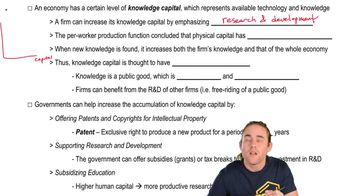
 06:15
06:15