Skip to main content
Microeconomics
My Course
Learn
Exam Prep
AI Tutor
Study Guides
Flashcards
Explore
Try the app
My Course
Learn
Exam Prep
AI Tutor
Study Guides
Flashcards
Explore
Try the app
Back
New Growth Theory quiz
You can tap to flip the card.
What is the main focus of New Growth Theory in explaining economic growth?
You can tap to flip the card.
👆
What is the main focus of New Growth Theory in explaining economic growth?
New Growth Theory focuses on technology and knowledge capital as the key drivers of economic growth.
Track progress
Control buttons has been changed to "navigation" mode.
1/15
Related flashcards
Recommended videos
New Growth Theory definitions
New Growth Theory
15 Terms
Guided course
06:15
New Growth Theory
5
views
Terms in this set (15)
Hide definitions
What is the main focus of New Growth Theory in explaining economic growth?
New Growth Theory focuses on technology and knowledge capital as the key drivers of economic growth.
How does technological change affect productivity according to New Growth Theory?
Technological change increases productivity growth by introducing new ways to produce more efficiently.
What is knowledge capital in the context of New Growth Theory?
Knowledge capital is the amount of knowledge and technology available in the economy, distinct from human capital.
How can firms increase their knowledge capital?
Firms can increase their knowledge capital by investing in research and development (R&D).
What is the difference between physical capital and knowledge capital in terms of returns?
Physical capital experiences diminishing returns, while knowledge capital can generate increasing returns.
Why does knowledge capital lead to increasing returns?
Because knowledge is a public good, its benefits can spread throughout the economy, allowing both firms and the economy to grow.
What are the two main characteristics of a public good?
A public good is non-rival (one person's use doesn't reduce availability to others) and non-excludable (it's hard to prevent others from using it).
How does the concept of free-riding relate to knowledge capital?
Free-riding occurs when firms benefit from the knowledge created by others without directly contributing to its development.
What role do patents play in New Growth Theory?
Patents give inventors exclusive rights to their inventions for a limited time, incentivizing innovation by protecting profits.
How long does a typical patent last in the United States?
A typical patent lasts for 20 years in the United States.
What happens to patented knowledge after the patent expires?
After the patent expires, the knowledge becomes a public good and can be used by others.
Besides patents, how can governments encourage the accumulation of knowledge capital?
Governments can offer subsidies, grants, or tax breaks to support research and development.
How does subsidizing education contribute to economic growth in New Growth Theory?
Subsidizing education increases human capital, making research and development more productive and likely to result in technological breakthroughs.
Why is knowledge capital considered non-rival and non-excludable?
Because one person's use of knowledge doesn't prevent others from using it, and it's difficult to stop others from accessing it once it's available.
What is the overall implication of New Growth Theory for long-run economic growth?
New Growth Theory suggests that policies promoting technology and knowledge capital can sustain long-run economic growth.
 BackBack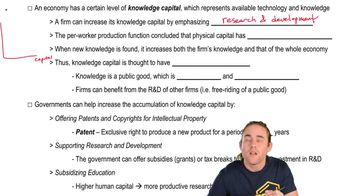
 06:15
06:15