Skip to main content
Microeconomics
My Course
Learn
Exam Prep
AI Tutor
Study Guides
Flashcards
Explore
Try the app
My Course
Learn
Exam Prep
AI Tutor
Study Guides
Flashcards
Explore
Try the app
Back
Perfect Competition and Efficiency definitions
You can tap to flip the card.
Perfect Competition
You can tap to flip the card.
👆
Perfect Competition
A market structure where many firms sell identical products, ensuring prices reflect both consumer and producer costs.
Track progress
Control buttons has been changed to "navigation" mode.
1/14
Related flashcards
Related practice
Recommended videos
Perfect Competition and Efficiency quiz #1
Perfect Competition and Efficiency
10 Terms
Perfect Competition and Efficiency
11. Perfect Competition
10 problems
Topic
Four Market Model Summary: Perfect Competition
11. Perfect Competition
10 problems
Topic
11. Perfect Competition
11 topics
15 problems
Chapter
Guided course
06:46
Efficiency in Perfect Competition
2284
views
19
rank
Terms in this set (14)
Hide definitions
Perfect Competition
A market structure where many firms sell identical products, ensuring prices reflect both consumer and producer costs.
Productive Efficiency
Occurs when production happens at the lowest possible cost, specifically at the minimum point of average total cost.
Allocative Efficiency
Achieved when the quantity produced matches consumer preferences, with marginal benefit equaling marginal cost.
Average Total Cost
Represents the per-unit cost of production, minimized when firms operate efficiently in perfect competition.
Marginal Benefit
The value consumers place on the last unit purchased, reflected by the market price at equilibrium.
Marginal Cost
The expense incurred by producers for making one additional unit, matched by price in efficient markets.
Equilibrium Price
The market price where supply meets demand, ensuring both productive and allocative efficiency.
Demand Curve
A graphical representation showing how consumer willingness to pay decreases as quantity increases.
Supply Curve
A graph illustrating how producers offer more goods as price rises, intersecting demand at equilibrium.
Marginal Revenue
The additional income a firm receives from selling one more unit, equal to price in perfect competition.
Consumer Preferences
The desires and priorities of buyers, guiding the allocation of resources in efficient markets.
Profit Maximizing Point
The output level where marginal revenue equals marginal cost, ensuring optimal firm performance.
Long Run
A period in which firms can adjust all inputs, leading to production at minimum average total cost.
Monopoly
A market structure with a single seller, typically failing to achieve both productive and allocative efficiency.
 BackBack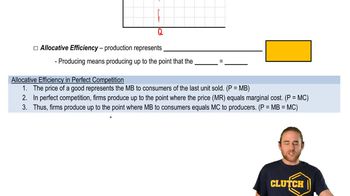
 06:46
06:46