Skip to main content
Microeconomics
My Course
Learn
Exam Prep
AI Tutor
Study Guides
Flashcards
Explore
Try the app
My Course
Learn
Exam Prep
AI Tutor
Study Guides
Flashcards
Explore
Try the app
Back
Phillips Curve and Expected Inflation definitions
You can tap to flip the card.
Phillips Curve
You can tap to flip the card.
👆
Phillips Curve
Graphical representation showing the relationship between inflation and unemployment, with distinct short-run and long-run interpretations.
Track progress
Control buttons has been changed to "navigation" mode.
1/15
Related flashcards
Recommended videos
Phillips Curve and Expected Inflation quiz
Phillips Curve and Expected Inflation
15 Terms
09:52
Expectations of Future Inflation
7
views
07:46
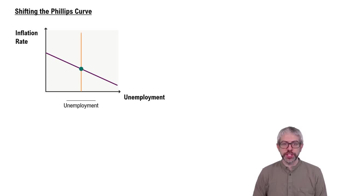
Shifting the Phillip's Curve
4
views
Terms in this set (15)
Hide definitions
Phillips Curve
Graphical representation showing the relationship between inflation and unemployment, with distinct short-run and long-run interpretations.
Short Run Phillips Curve
Curve illustrating an inverse relationship between inflation and unemployment, valid when actual inflation differs from expected inflation.
Long Run Phillips Curve
Vertical curve indicating no trade-off between inflation and unemployment, always aligning with the natural rate of unemployment.
Natural Rate of Unemployment
Level of unemployment where the economy returns regardless of inflation, as predicted by the long run Phillips curve.
Expected Inflation
Anticipated rate of price increase, influencing wage agreements and labor demand, and shifting the short run Phillips curve.
Actual Inflation
Observed rate of price increase, which, when different from expectations, temporarily alters unemployment levels.
Nominal Wage
Stated wage amount before adjusting for inflation, used by businesses to set pay for workers.
Real Wage
Purchasing power of wages after accounting for inflation, affecting labor costs and hiring decisions.
Trade-off
Short-run inverse relationship between inflation and unemployment, absent in the long run according to economic theory.
Equilibrium
State where actual inflation matches expected inflation, causing both Phillips curves to intersect and unemployment to stabilize.
Labor Demand
Employer desire for workers, influenced by perceived real wage changes due to differences in inflation rates.
Purchasing Power
Ability of wages to buy goods and services, diminished when inflation exceeds expectations.
Curve Shift
Movement of the short run Phillips curve to intersect the long run curve at a new expected inflation rate.
Macroeconomic Expectations
Beliefs about future inflation, crucial for understanding short-run deviations and long-run outcomes in unemployment.
Input Prices
Costs businesses incur for resources, rising with inflation and affecting the relative attractiveness of labor.
 BackBack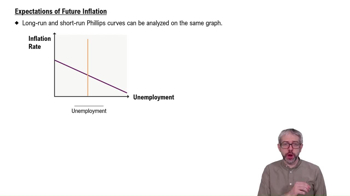
 09:52
09:52