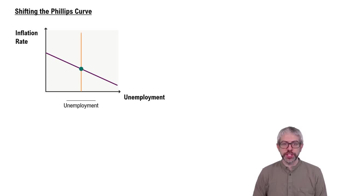
What does the long run Phillips curve suggest about the relationship between inflation and unemployment?
The long run Phillips curve suggests there is no strong relationship between inflation and unemployment; regardless of the inflation rate, unemployment returns to its natural rate.
How does the short run Phillips curve describe the relationship between inflation and unemployment?
The short run Phillips curve shows an inverse relationship: higher inflation is associated with lower unemployment, and lower inflation with higher unemployment.
Why do the short run and long run Phillips curves appear to contradict each other?
The short run Phillips curve predicts a trade-off between inflation and unemployment, while the long run Phillips curve predicts no such trade-off.
What role does expected inflation play in the short run Phillips curve?
Expected inflation influences the short run Phillips curve by causing deviations in unemployment when actual inflation differs from what was expected.
What happens to real wages when actual inflation is higher than expected inflation?
Real wages decrease because inflation erodes purchasing power more than anticipated, making labor cheaper for employers.
How do businesses respond when labor becomes cheaper due to higher-than-expected inflation?
Businesses are likely to hire more workers, which decreases the unemployment rate in the short run.
What is the effect on unemployment when actual inflation is lower than expected inflation?
Unemployment increases because real wages are higher than expected, making labor more expensive for employers.
At what point do the short run and long run Phillips curves make the same prediction?
They make the same prediction when actual inflation equals expected inflation.
What must change for the economy to return to the long run Phillips curve after a deviation?
Expectations about inflation must adjust to match the new actual inflation rate.
How does the short run Phillips curve shift when expected inflation increases?
The short run Phillips curve shifts upward (to the right), intersecting the long run Phillips curve at the new, higher expected inflation rate.
Why does the short run Phillips curve shift when expectations change?
It shifts because the relationship between inflation and unemployment depends on the expected rate of inflation, not just the actual rate.
What is the natural rate of unemployment?
The natural rate of unemployment is the rate the economy returns to in the long run, regardless of the inflation rate.
How does repeated higher-than-expected inflation affect expectations?
If people experience higher inflation repeatedly, they adjust their expectations upward to match the new reality.
What does the long run Phillips curve predict about the trade-off between inflation and unemployment?
It predicts there is no long-term trade-off; unemployment returns to its natural rate regardless of inflation.
How does the Phillips curve model help explain short-term versus long-term economic outcomes?
It shows that in the short run, unexpected inflation can reduce unemployment, but in the long run, expectations adjust and unemployment returns to its natural rate.
 Back
Back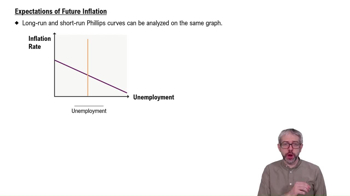
 09:52
09:52