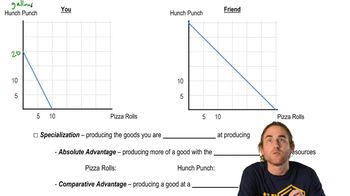
What is the benefit of having an absolute advantage in the production of one good?
The benefit is that a producer can make more of that good using the same resources, leading to greater efficiency and higher output.
What is the difference between absolute advantage and comparative advantage?
Absolute advantage is the ability to produce more of a good with the same resources, while comparative advantage is the ability to produce a good at a lower opportunity cost.
Which quality best describes a producer with an absolute advantage: efficient, fast, accurate, or prolific?
Efficient best describes a producer with an absolute advantage, as they can produce more output with the same resources.
True or false: Higher opportunity costs equal a greater comparative advantage.
False. Comparative advantage is based on having a lower opportunity cost, not a higher one.
Are the ratios 6:2 and 9:3 equivalent in terms of opportunity cost calculations?
Yes, both ratios simplify to 3:1, so they are equivalent for opportunity cost calculations.
What is the difference between absolute advantage and comparative advantage?
Absolute advantage refers to producing more with the same resources, while comparative advantage refers to producing at a lower opportunity cost.
Given two producers, which manufacturer has the absolute advantage?
The manufacturer who can produce more of a good with the same resources has the absolute advantage.
What is the best measurement to use to determine who might have the absolute advantage?
The best measurement is the maximum output of a good that each producer can achieve with the same resources.
Which describes a way in which consumers most likely benefit from producers’ absolute advantage?
Consumers benefit from lower prices and greater availability of goods when producers have an absolute advantage.
Which calculation helps determine which producer has the absolute advantage?
Comparing the maximum output of each producer for a given good determines who has the absolute advantage.
Who has the absolute advantage in selling salads?
The person who can sell more salads using the same resources has the absolute advantage.
Who has the absolute advantage in selling coffees?
The person who can sell more coffees using the same resources has the absolute advantage.
What is the relationship between production costs and comparative advantage?
Comparative advantage is determined by lower opportunity costs, not necessarily lower production costs.
What idea is closely linked to the theory of absolute advantage?
Specialization is closely linked to absolute advantage, as producers focus on goods they produce most efficiently.
Which quality best describes a producer with an absolute advantage?
Efficient, as they can produce more output with the same resources.
Who has the comparative advantage in selling pastries?
The person who can sell pastries at a lower opportunity cost has the comparative advantage.
How is comparative advantage best described?
Comparative advantage is the ability to produce a good at a lower opportunity cost than another producer.
A producer with a comparative advantage has the ability to produce a good or service at what cost?
At a lower opportunity cost than other producers.
If a nation has a comparative disadvantage in the production of some commodity, what should it do?
It should specialize in goods where it has a comparative advantage and trade for goods where it has a comparative disadvantage.
A country with an absolute advantage can produce a good or service how?
It can produce more of the good or service using the same amount of resources as other countries.
Who has the comparative advantage in selling smoothies?
The person who can sell smoothies at a lower opportunity cost has the comparative advantage.
What is the definition of comparative advantage?
Comparative advantage is the ability to produce a good at a lower opportunity cost than another producer.
What does 'the ability to produce a good using fewer inputs than another producer' describe?
This describes absolute advantage.
How is absolute advantage found when comparing different producers?
By comparing which producer can make more of a good with the same resources.
When a country has a comparative advantage in the production of a good, what should it do?
It should specialize in producing that good and trade for others.
Absolute advantage is found by comparing different producers’ what?
By comparing their maximum outputs for a given good using the same resources.
How can we determine absolute advantage by comparing different producers?
By evaluating which producer can produce more of a good with the same amount of resources.
 Back
Back
 06:30
06:30