Skip to main content
Microeconomics
My Course
Learn
Exam Prep
AI Tutor
Study Guides
Flashcards
Explore
Try the app
My Course
Learn
Exam Prep
AI Tutor
Study Guides
Flashcards
Explore
Try the app
Back
Price Discrimination definitions
You can tap to flip the card.
Price Discrimination
You can tap to flip the card.
👆
Price Discrimination
Selling identical goods at varying prices to different buyers, based on their willingness to pay, maximizing firm profit.
Track progress
Control buttons has been changed to "navigation" mode.
1/15
Related flashcards
Related practice
Recommended videos
Price Discrimination quiz #1
Price Discrimination
37 Terms
Price Discrimination
12. Monopoly
10 problems
Topic
Antitrust Laws and Government Regulation of Monopolies
12. Monopoly
10 problems
Topic
12. Monopoly
9 topics
13 problems
Chapter
Guided course
04:05
Price Discrimination
1875
views
15
rank
Guided course
06:11
Perfect Price Discrimination
2218
views
26
rank
Guided course
07:45
Price Discrimination
2934
views
27
rank
Terms in this set (15)
Hide definitions
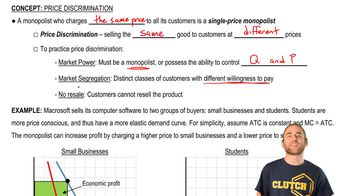
Price Discrimination
Selling identical goods at varying prices to different buyers, based on their willingness to pay, maximizing firm profit.
Market Power
Ability of a firm to control price and quantity, enabling it to set prices above competitive levels.
Monopoly
Single seller dominating a market, possessing the power to influence prices and restrict output.
Elasticity of Demand
Measure of how sensitive buyers are to price changes, affecting their willingness to pay.
Segregation
Division of customers into distinct groups based on characteristics like willingness to pay.
Resale
Transfer of purchased goods from one buyer to another, undermining price discrimination strategies.
Consumer Surplus
Difference between what buyers are willing to pay and what they actually pay, representing buyer benefit.
Deadweight Loss
Lost economic value from trades that do not occur, often due to restricted output or inefficient pricing.
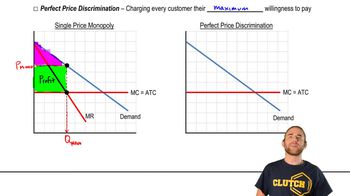
Perfect Price Discrimination
Charging each buyer their maximum willingness to pay, eliminating consumer surplus and deadweight loss.
Marginal Revenue
Additional income earned from selling one more unit, guiding output and pricing decisions.
Marginal Cost
Extra expense incurred from producing one additional unit, crucial for profit maximization.
Efficient Quantity
Output level where marginal cost equals price, maximizing total welfare in a market.
Economic Profit
Earnings exceeding all costs, including opportunity costs, often visualized as the area between price and average total cost.
Auction
Competitive process where buyers bid for goods, revealing their maximum willingness to pay.
Willingness to Pay
Maximum amount a buyer is prepared to spend for a good, determining pricing in discrimination strategies.
 BackBack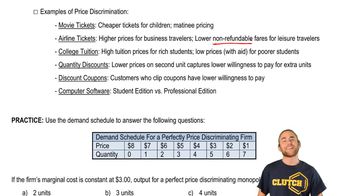
 04:05
04:05