Short Run Shutdown Decision quiz #1 Flashcards

Short Run Shutdown Decision quiz #1
Control buttons has been changed to "navigation" mode.
1/10
  • In the short run, what can a firm that produces and sells house paint adjust in response to market conditions?
    In the short run, a firm can adjust its level of output and variable inputs (like labor and materials), but cannot change its fixed costs or exit the market permanently.
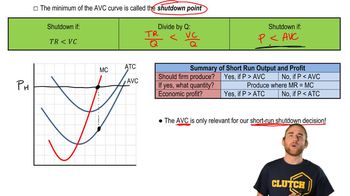
  • At which point will a firm be indifferent between shutting down and continuing to produce in the short run?
    A firm will be indifferent between shutting down and continuing to produce when the market price equals the minimum average variable cost; at this point, revenue just covers variable costs.
  • Based on a chart showing costs and prices, at which price will a firm decide to shut down in the short run?
    A firm will shut down in the short run if the market price falls below the minimum average variable cost, as it cannot cover its variable costs.
  • Which condition represents a firm's short-run decision to shut down?
    A firm's short-run shutdown condition is when the market price is less than the average variable cost at the profit-maximizing output.
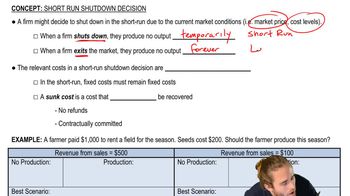
  • What is the difference between a firm's shutdown and exit decisions?
    Shutdown is a temporary halt in production in the short run, while exit is a permanent departure from the market in the long run.
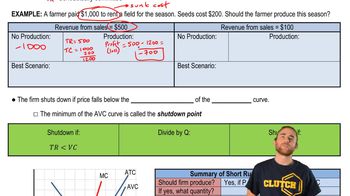
  • Why are fixed costs considered sunk costs in the short run shutdown decision?
    Fixed costs are considered sunk because they must be paid regardless of whether the firm produces or not, and cannot be recovered in the short run.
  • In the context of the shutdown decision, what role does average variable cost play?
    Average variable cost determines the shutdown point; if the market price falls below the minimum average variable cost, the firm should shut down.
  • How does a firm use marginal cost and marginal revenue to determine its production level if it decides to produce?
    A firm produces at the quantity where marginal cost equals marginal revenue, which in perfect competition is also where price equals marginal cost.
  • If a firm is producing at a loss but the price is above average variable cost, why might it continue to operate in the short run?
    The firm continues to operate because it can cover its variable costs and reduce its losses compared to shutting down, which would leave it with all fixed costs as losses.
  • When analyzing a cost graph, what does the intersection of the price line and the minimum average variable cost indicate?
    The intersection marks the shutdown point; at this price, the firm is indifferent between producing and shutting down because revenue just covers variable costs.