Skip to main content
Microeconomics
My Course
Learn
Exam Prep
AI Tutor
Study Guides
Flashcards
Explore
Try the app
My Course
Learn
Exam Prep
AI Tutor
Study Guides
Flashcards
Explore
Try the app
Back
Slope of Linear Graphs definitions
You can tap to flip the card.
Slope
You can tap to flip the card.
👆
Slope
Ratio of vertical change to horizontal change between two points, indicating direction and steepness of a line.
Track progress
Control buttons has been changed to "navigation" mode.
1/15
Related flashcards
Related practice
Recommended videos
Slope of Linear Graphs quiz #1
Slope of Linear Graphs
10 Terms
Slope of Linear Graphs
1. Reading and Understanding Graphs
10 problems
Topic
Slope of a Curve at a Point
1. Reading and Understanding Graphs
10 problems
Topic
1. Reading and Understanding Graphs
9 topics
15 problems
Chapter
Guided course
07:47
Calculating Slope of a Straight Line
4402
views
60
rank
Terms in this set (15)
Hide definitions
Slope
Ratio of vertical change to horizontal change between two points, indicating direction and steepness of a line.
Rise
Amount of change along the vertical axis between two points, positive for upward movement and negative for downward.
Run
Amount of change along the horizontal axis between two points, positive for rightward movement and negative for leftward.
Vertical Axis
Reference line on a graph representing values that change up or down, typically labeled as Y.
Horizontal Axis
Reference line on a graph representing values that change left or right, typically labeled as X.
Intersection
Point where a line crosses grid lines on a graph, used for accurate slope calculation.
Positive Slope
Line characteristic where movement from left to right results in an upward trend, indicating growth.
Negative Slope
Line characteristic where movement from left to right results in a downward trend, indicating decline.
Steepness
Degree to which a line inclines or declines, with larger absolute slope values indicating greater tilt.
Grid Lines
Horizontal and vertical lines on a graph that help identify exact points for calculations.
Fraction
Numerical expression representing the ratio of rise to run, used to describe slope values.
Trend
General direction in which a line moves, either upward or downward, as shown by the slope.
Uphill
Visual representation of a line with positive slope, moving upward from left to right.
Downhill
Visual representation of a line with negative slope, moving downward from left to right.
Point
Specific location on a graph defined by coordinates, used to determine rise and run for slope calculation.
 BackBack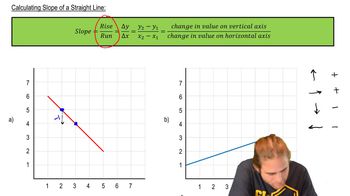
 07:47
07:47