Skip to main content
Microeconomics
My Course
Learn
Exam Prep
AI Tutor
Study Guides
Flashcards
Explore
Try the app
My Course
Learn
Exam Prep
AI Tutor
Study Guides
Flashcards
Explore
Try the app
Back
The Bretton Woods System definitions
You can tap to flip the card.
Bretton Woods System
You can tap to flip the card.
👆
Bretton Woods System
A post-WWII arrangement linking currencies to the US dollar, which was convertible to gold, aiming for global exchange rate stability.
Track progress
Control buttons has been changed to "navigation" mode.
1/15
Related flashcards
Recommended videos
The Bretton Woods System quiz
The Bretton Woods System
15 Terms
Guided course
04:04
Bretton Woods System: Introduction
6
views
Guided course
02:53
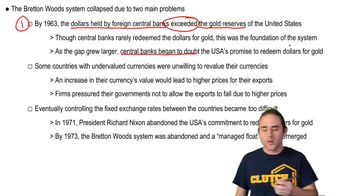
Bretton Woods System: Collapse
6
views
Terms in this set (15)
Hide definitions
Bretton Woods System
A post-WWII arrangement linking currencies to the US dollar, which was convertible to gold, aiming for global exchange rate stability.
Fixed Exchange Rate
A currency value maintained at a set level against another currency, preventing market-driven fluctuations.
US Dollar
The central currency in the system, pegged to gold and used as the anchor for other currencies' values.
Gold Reserves
Stores of precious metal held by central banks, backing the value of the US dollar during the system's operation.
Central Bank
National financial authority responsible for holding reserves and managing currency exchange under the system.
International Monetary Fund
An institution created to lend reserves to countries facing shortages, helping maintain exchange rate stability.
Dollar Reserves
Foreign holdings of US currency, used as a substitute for gold to support national currencies.
Undervalued Currency
A national currency set below its market equilibrium, often to boost exports and create trade imbalances.
Surplus
An excess supply of a currency resulting from fixed rates, often leading to imbalances in international trade.
Shortage
A deficit in currency supply caused by fixed rates, disrupting equilibrium and prompting intervention.
Equilibrium
A state where supply and demand for a currency are balanced, typically absent in fixed rate systems.
Managed Float System
A post-1973 arrangement where exchange rates are mostly market-driven, with occasional government intervention.
Revaluation
An upward adjustment of a currency's fixed value, often resisted to protect export competitiveness.
Inflation
A general rise in prices, often triggered by governments printing money to address currency shortages.
Export
Goods or services sold abroad, whose prices are affected by currency valuation under fixed exchange systems.
 BackBack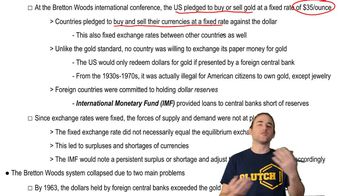
 04:04
04:04