Skip to main content
Microeconomics
My Course
Learn
Exam Prep
AI Tutor
Study Guides
Flashcards
Explore
Try the app
My Course
Learn
Exam Prep
AI Tutor
Study Guides
Flashcards
Explore
Try the app
Back
The Bretton Woods System quiz
You can tap to flip the card.
What was the main feature of the Bretton Woods system established after World War II?
You can tap to flip the card.
👆
What was the main feature of the Bretton Woods system established after World War II?
It established fixed exchange rates by pegging currencies to the US dollar, which was convertible to gold at \$35 per ounce.
Track progress
Control buttons has been changed to "navigation" mode.
1/15
Related flashcards
Recommended videos
The Bretton Woods System definitions
The Bretton Woods System
15 Terms
Guided course
04:04
Bretton Woods System: Introduction
6
views
Guided course
02:53
Bretton Woods System: Collapse
6
views
Terms in this set (15)
Hide definitions
What was the main feature of the Bretton Woods system established after World War II?
It established fixed exchange rates by pegging currencies to the US dollar, which was convertible to gold at \$35 per ounce.
Why is the system called the Bretton Woods system?
It is named after the Bretton Woods conference held in New Hampshire where the system was created.
How did countries fix their exchange rates under the Bretton Woods system?
Countries fixed their currencies to the US dollar, which was itself fixed to gold.
Who could redeem US dollars for gold under the Bretton Woods system?
Only foreign central banks could redeem US dollars for gold, not regular citizens.
What role did the International Monetary Fund (IMF) play in the Bretton Woods system?
The IMF provided loans to central banks that were short of dollar reserves to help maintain fixed exchange rates.
Why were fixed exchange rates not always at equilibrium under the Bretton Woods system?
Because the rates were set by governments, not by supply and demand, leading to possible shortages or surpluses of currencies.
What happened if a currency was undervalued in the Bretton Woods system?
There would be excess demand for the currency, but countries often resisted revaluing to protect their export industries.
Why did some countries resist revaluing their undervalued currencies?
They feared that revaluation would make their exports more expensive and hurt their businesses.
What was a major problem that led to the collapse of the Bretton Woods system?
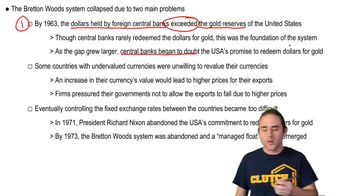
By the 1960s, foreign central banks held more US dollars than the US had gold to back them, causing doubts about dollar-gold convertibility.
When did the United States end the dollar’s convertibility to gold?
President Richard Nixon ended the dollar’s convertibility to gold in 1971.
What system replaced the Bretton Woods system after its collapse?
The managed float system replaced Bretton Woods, where exchange rates are mostly determined by supply and demand.
How can governments influence exchange rates in the managed float system?
Governments can intervene by buying or selling their own currency to address market failures or maintain equilibrium.
Was it legal for American citizens to own gold during the Bretton Woods era?
No, it was illegal for American citizens to own gold as an investment during this period.
What economic problems did the refusal to revalue currencies cause under Bretton Woods?
It led to shortages of certain currencies, forced governments to print more money, and contributed to inflation.
How long did the Bretton Woods system last?
The Bretton Woods system lasted from 1944 to 1973.
 BackBack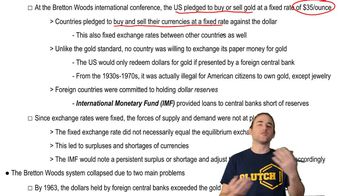
 04:04
04:04