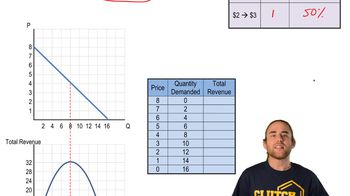
Refer to Figure 5-1. With reference to graph A, at a price of $5, what is the total revenue?
Total revenue at a price of $5 is calculated by multiplying the price ($5) by the quantity demanded at that price. Using the method described in the lesson, find the quantity corresponding to $5 on the demand curve and multiply: Total Revenue = Price × Quantity. For example, if the quantity demanded at $5 is 6 units, total revenue would be $5 × 6 = $30.
How does the percentage change in price differ when moving from $1 to $2 compared to $2 to $3 on a linear demand curve?
The percentage change from $1 to $2 is 100%, while from $2 to $3 it is only 50%, even though both are a unit change of $1.
What is the relationship between slope and elasticity on a demand curve?
Slope measures the unit change between variables, while elasticity measures the percentage change; they are related but not the same.
Where is the unit elastic point located on a linear demand curve?
The unit elastic point is at the midpoint of the demand curve, where it intersects the price and quantity axes.
What happens to total revenue as you move from the elastic to the inelastic section of a linear demand curve?
Total revenue increases up to the unit elastic point and then decreases as you move into the inelastic section.
Why does total revenue increase in the elastic section of the demand curve?
In the elastic section, the percentage increase in quantity demanded is greater than the percentage decrease in price, causing total revenue to rise.
What is the effect on total revenue when price decreases in the inelastic section of the demand curve?
In the inelastic section, total revenue falls because the percentage decrease in price is greater than the percentage increase in quantity demanded.
How can you visually identify the elastic, unit elastic, and inelastic regions on a linear demand curve?
The elastic region is to the left of the midpoint, the unit elastic point is at the midpoint, and the inelastic region is to the right of the midpoint.
What does the total revenue versus quantity graph illustrate about revenue changes along the demand curve?
It shows that total revenue rises to a maximum at the unit elastic point and then falls as quantity increases further.
Why is the unit elastic point considered the optimal point for maximizing revenue on a linear demand curve?
At the unit elastic point, total revenue is maximized because the percentage change in quantity demanded equals the percentage change in price.