Skip to main content
Microeconomics
My Course
Learn
Exam Prep
AI Tutor
Study Guides
Flashcards
Explore
Try the app
My Course
Learn
Exam Prep
AI Tutor
Study Guides
Flashcards
Explore
Try the app
Back
Unions definitions
You can tap to flip the card.
Labor Union
You can tap to flip the card.
👆
Labor Union
An organized group of workers negotiating as a collective to secure improved wages and working conditions from employers.
Track progress
Control buttons has been changed to "navigation" mode.
1/15
Related flashcards
Related practice
Recommended videos
Unions quiz
Unions
15 Terms
Unions
15. Markets for the Factors of Production
10 problems
Topic
Monopsony
15. Markets for the Factors of Production
10 problems
Topic
15. Markets for the Factors of Production
10 topics
13 problems
Chapter
Guided course
06:50
Labor Unions
1924
views
19
rank
Terms in this set (15)
Hide definitions
Labor Union
An organized group of workers negotiating as a collective to secure improved wages and working conditions from employers.
Collective Bargaining
A process where workers negotiate together, leveraging group strength to achieve better pay and conditions.
Industrial Revolution
A historical period marked by worker exploitation, prompting the creation of labor laws and worker organizations.
Labor Law
Regulations established to protect workers from abuses and ensure fair treatment in the workplace.
Labor Market Equilibrium
A point where the supply of workers and the demand for labor balance, determining wage and job levels.
Apprenticeship Program
A structured training pathway required for union membership, enhancing worker skills and job qualifications.
Job Qualification Standard
Criteria set by unions or employers that workers must meet, often involving certification or specialized training.
Unionized Worker
An employee who belongs to a labor organization, typically possessing higher skills due to required training.
Marginal Production of Labor
The additional output generated by a worker, often increased through union-driven training and certification.
Minimum Wage Law
Legislation supported by unions that sets a wage floor, influencing firms to hire more skilled labor.
Equilibrium Wage
The prevailing pay rate in the labor market, often elevated by union actions and collective negotiations.
Equilibrium Quantity
The number of jobs available at the market wage, typically reduced when unions restrict labor supply.
Union Membership
The proportion of workers affiliated with labor organizations, varying widely across countries and time periods.
Labor Supply
The total number of workers available for employment, which unions can restrict to raise wages.
Labor Demand
The need for workers by firms, often increased for skilled labor when unions influence training and wage standards.
 BackBack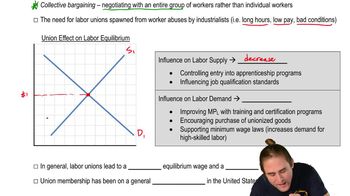
 06:50
06:50