Skip to main content
Microeconomics
My Course
Learn
Exam Prep
AI Tutor
Study Guides
Flashcards
Explore
Try the app
My Course
Learn
Exam Prep
AI Tutor
Study Guides
Flashcards
Explore
Try the app
Back
Unions quiz
You can tap to flip the card.
What is the main purpose of a labor union?
You can tap to flip the card.
👆
What is the main purpose of a labor union?
The main purpose of a labor union is for workers to join together to negotiate collectively for higher wages and better working conditions.
Track progress
Control buttons has been changed to "navigation" mode.
1/15
Related flashcards
Related practice
Recommended videos
Unions definitions
Unions
15 Terms
Unions
15. Markets for the Factors of Production
10 problems
Topic
Monopsony
15. Markets for the Factors of Production
10 problems
Topic
15. Markets for the Factors of Production
10 topics
13 problems
Chapter
Guided course
06:50
Labor Unions
1924
views
19
rank
Terms in this set (15)
Hide definitions
What is the main purpose of a labor union?
The main purpose of a labor union is for workers to join together to negotiate collectively for higher wages and better working conditions.
What negotiation tool do labor unions use to achieve their goals?
Labor unions use collective bargaining, where workers negotiate as a group rather than individually.
Why did labor unions originally form during the Industrial Revolution?
Labor unions formed in response to worker abuses such as long hours, low pay, and poor working conditions.
How do unions affect the supply of labor in the market?
Unions restrict the supply of labor by requiring membership, training, and certification, which reduces the number of eligible workers.
What is the typical effect of unions on equilibrium wages?
Unions generally increase equilibrium wages for their members.
How do unions influence job qualification standards?
Unions often require apprenticeship programs and technical certifications, raising the standards needed to get certain jobs.
Why are unionized workers often more skilled than non-unionized workers?
Unionized workers are often more skilled because unions require training and certification programs.
How do unions impact the demand for labor?
Unions can increase the demand for labor by making workers more productive and supporting minimum wage laws that favor skilled workers.
What happens to the equilibrium quantity of jobs when a union is formed?
The equilibrium quantity of jobs usually decreases, meaning there are fewer jobs available but at higher wages.
How do minimum wage laws supported by unions affect the labor market?
Minimum wage laws can increase demand for skilled labor, as firms prefer to hire more productive workers at higher wages.
What is collective bargaining?
Collective bargaining is when workers negotiate together as a group for better wages and conditions.
What is the current union membership rate in the United States?
About 10% of workers in the United States are currently unionized.
How does union membership in Sweden compare to the United States?
Union membership in Sweden is much higher, with up to 70% of workers in unions.
What is the overall effect of unions on wages and employment?
Unions typically lead to higher wages but fewer jobs for unionized workers.
Why might firms prefer to hire unionized workers when minimum wage laws are in place?
Firms prefer to hire unionized workers because they are more skilled and productive, making higher wages more worthwhile.
 BackBack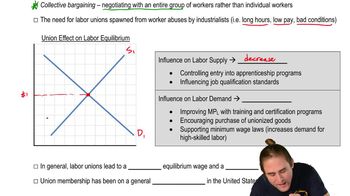
 06:50
06:50