 Back
BackAnalyzing Economic Surplus and Price Controls in Microeconomics
Study Guide - Smart Notes
 Tailored notes based on your materials, expanded with key definitions, examples, and context.
Q1. Compare the economic surplus in this market when there is no tax to when there is a tax on pizzas.
Background
Topic: Economic Surplus, Price Controls, and Tax Incidence
This question tests your understanding of how taxes affect economic surplus in a market. You are asked to compare the total benefit to society (consumer surplus + producer surplus) before and after a government-imposed tax changes the equilibrium price and quantity.
Key Terms and Formulas
Economic Surplus: The sum of consumer surplus and producer surplus in a market.
Consumer Surplus: The area between the demand curve and the price paid, up to the quantity bought.
Producer Surplus: The area between the supply curve and the price received, up to the quantity sold.
Deadweight Loss: The reduction in economic surplus due to market inefficiency (such as a tax).
Key formula:
Step-by-Step Guidance
Identify the equilibrium price and quantity before the tax: , million pizzas per month.
Determine the new equilibrium price and quantity after the tax: , million pizzas per month.
Sketch or analyze the areas representing consumer surplus and producer surplus before and after the tax. Use the demand and supply curves to visualize these areas.
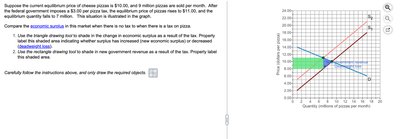
Calculate the change in economic surplus by comparing the sum of consumer and producer surplus before and after the tax. Identify the deadweight loss area created by the tax.
Try solving on your own before revealing the answer!
Final Answer:
After the tax, economic surplus decreases due to the deadweight loss. The shaded area between the new and old equilibrium quantities on the graph represents this loss. Both consumer and producer surplus shrink, and the government collects tax revenue equal to the rectangle between the new price and the old price, multiplied by the new quantity.
Economic surplus is maximized without the tax, and the imposition of the tax reduces it by the deadweight loss.
