 Back
BackChapter 1: What is Economics? — Foundations of Microeconomics
Study Guide - Smart Notes
 Tailored notes based on your materials, expanded with key definitions, examples, and context.
What is Economics?
Introduction to Economics
Economics is the social science that studies how individuals, businesses, governments, and societies make choices to allocate scarce resources. All economic questions arise because our wants exceed the resources available, a condition known as scarcity. Because of scarcity, choices must be made, and these choices are influenced by incentives—rewards or penalties that encourage or discourage actions.
Scarcity: The fundamental economic problem of having seemingly unlimited human wants in a world of limited resources.
Economics: The study of how people choose to allocate scarce resources to satisfy their wants.
Incentive: A reward or penalty that motivates behavior.
Microeconomics vs. Macroeconomics
Microeconomics (Econ 101): Focuses on individual choices and the behavior of individual units, such as households and firms.
Macroeconomics (Econ 102): Studies the economy as a whole, including issues like inflation, unemployment, and economic growth.
The Scope of Economics: Two Big Questions
What, How, and For Whom?
Economics seeks to answer three core questions:
What goods and services are produced?
How are these goods and services produced?
For whom are goods and services produced?
Goods and services are produced using factors of production (inputs):
Land: Natural resources
Labor: Human effort, including human capital (skills and knowledge)
Capital: Physical capital such as machinery, buildings, and tools
Entrepreneurship: The human resource that organizes land, labor, and capital
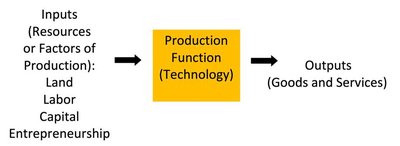
Production is the process of transforming inputs into outputs using technology.
Distribution of Income
The distribution of goods and services depends on the incomes earned by the owners of the factors of production:
Land earns rent
Labor earns wages
Capital earns interest
Entrepreneurship earns profit
Self-Interest vs. Social Interest
Choices made in self-interest may or may not align with the social interest. Social interest has two dimensions:
Efficiency: Resource use is efficient if it is not possible to make someone better off without making someone else worse off.
Equity: Fairness in the distribution of resources, though definitions of fairness vary among economists.
The Economic Way of Thinking
Rational Choices and Tradeoffs
Economists assume that people act rationally, making choices to maximize their benefit given their constraints. Every choice involves a tradeoff: giving up one thing to get something else.
Opportunity Cost: The highest-valued alternative forgone when a choice is made. In economics, all costs are opportunity costs.
Marginal Analysis
Most choices are made at the margin, meaning people consider the consequences of incremental changes in resource use.
Marginal Benefit (MB): The additional benefit from one more unit of an activity.
Marginal Cost (MC): The additional cost from one more unit of an activity.
Rules of Marginal Analysis:
If MB > MC, do more of the activity.
If MC > MB, do less of the activity.
Positive vs. Normative Statements
Economists distinguish between:
Positive Statements: Statements that can be tested against facts (objective).
Normative Statements: Statements that involve value judgments and cannot be tested (subjective).
The Scientific Method in Economics
Economists use the scientific method to build and test models:
Observation and measurement
Formulating hypotheses (economic models)
Testing models using empirical data (natural experiments, statistical investigations, economic experiments)
Models that consistently predict outcomes are called theories.
Ceteris Paribus Assumption
To isolate cause and effect, economists use the ceteris paribus assumption—holding all other variables constant except the one being studied.
Making and Using Graphs in Economics
Graphs in Economic Models
Graphs are used to illustrate relationships between economic variables. The slope of a curve shows the nature and strength of the relationship between two variables. Moving along a curve shows the effect of changing one variable, while shifting the curve shows the effect of changing a third variable held constant.
Relationships Involving More Than Two Variables
When more than two variables are involved, economists use the ceteris paribus assumption to analyze the relationship between two variables while holding others constant. If a third variable changes, the entire curve shifts, indicating a new relationship.
Skills and Careers in Economics
Economics majors develop critical-thinking, analytical, math, writing, and oral communication skills. These are highly valued in a variety of careers, and the number of economics jobs is expected to grow.
Summary Table: Factors of Production and Their Incomes
Factor of Production | Definition | Income Earned | Example |
|---|---|---|---|
Land | Natural resources | Rent | Farmland, minerals |
Labor | Human effort | Wages | Factory worker, teacher |
Capital | Physical tools and machinery | Interest | Machines, computers |
Entrepreneurship | Organization of resources | Profit | Business owner |
Key Formulas
Opportunity Cost:
Profit:
Slope of a Line:
Additional info: This summary includes expanded academic context and examples to ensure the notes are self-contained and suitable for exam preparation.
