 Back
Chapter 7: Consumer Choice – Utility Theory and Optimizing Consumption
Study Guide - Smart Notes
 Tailored notes based on your materials, expanded with key definitions, examples, and context.
Chpt 7. Consumer Choice
Utility Theory
Utility theory is central to understanding how consumers make choices to maximize satisfaction given their limited resources. Utility refers to the want-satisfying power of a good or service, and is measured in hypothetical units called utils. Although utils cannot be scientifically measured, they allow economists to analyze and quantify consumer behavior.
Total Utility: The overall satisfaction received from consuming a certain quantity of goods or services.
Marginal Utility: The additional satisfaction gained from consuming one more unit of a good or service.
Utility Analysis: The study of consumer decision-making based on maximizing utility.
Decision Making on the Margin: Consumers compare the marginal benefit with the marginal cost when deciding how much to consume.
Example: If a person buys more coffee than tea (when both are priced the same), it is inferred that coffee provides more utility to that person.
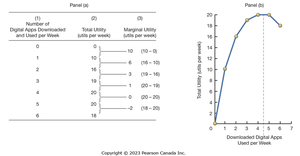
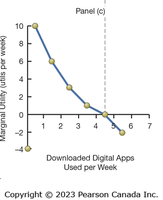
Diminishing Marginal Utility
The Law of Diminishing Marginal Utility states that as more of any good or service is consumed, the extra benefit (marginal utility) from each additional unit declines. This means increases in total utility become smaller as more is consumed during a given period.
Key Point: Marginal utility ultimately falls as a person consumes more of an item.
Example: The first helping at a buffet provides more satisfaction than the third helping.
Formula for Marginal Utility:
Optimizing Consumption Choices
Consumer Optimum
The consumer optimum is the combination of goods and services that maximizes satisfaction for a consumer, given their income and the prices of goods. The optimum depends on:
Income of the consumer
Prices of various goods/services
Marginal utility derived from consuming each good/service
Consumers aim to equalize the marginal utility per dollar spent across all items to achieve the optimum.
Rule of Equal Marginal Utilities per Dollar Spent
To maximize utility, consumers allocate their income so that the last dollar spent on each good yields the same marginal utility. This is known as the equimarginal principle.
Marginal Utility per Dollar:
Consumers purchase the good with the highest marginal utility per dollar until income is exhausted.
Consumer optimum is reached when marginal utility per dollar spent is equal across all goods.
Example: If digital apps cost $5 and wireless earbuds cost $3, and the consumer's income is $26, the optimum is found by comparing marginal utility per dollar for each good and allocating income accordingly.
Consumer Optimum: 4 digital apps and 2 wireless ear buds, where marginal utility per dollar spent is equalized and income is fully spent.
Price Changes and Consumer Optimum (Omitted for Exam)
Effect of Price Change on Consumer Optimum
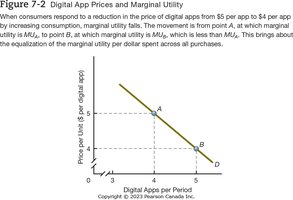
When the price of a good falls, consumers increase consumption, causing marginal utility to decrease. The new optimum is where marginal utility per dollar spent is again equalized across all goods.
The Diamond-Water Paradox
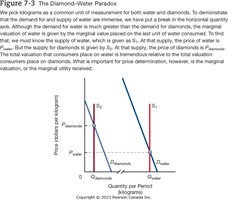
This paradox illustrates the difference between total utility and marginal utility in price determination. Water is essential and provides high total utility, but its price is low due to low marginal utility. Diamonds, though not essential, have high marginal utility and thus command a higher price.
Summary of Learning Objectives
Total vs. Marginal Utility: Total utility is the overall satisfaction from consumption; marginal utility is the additional satisfaction from consuming one more unit.
Diminishing Marginal Utility: Marginal utility declines as more of a good is consumed.
Consumer Optimum: Achieved when marginal utility per dollar spent is equalized across all items and income is fully spent.
Additional info:
Material on substitution and real-income effects, and behavioral economics is omitted as per course scope.
