 Back
Chapter 9 Study Guide
Study Guide - Smart Notes
 Tailored notes based on your materials, expanded with key definitions, examples, and context.
Comparative Advantage and the Gains from International Trade
The United States in the International Economy
International trade has become increasingly important to the U.S. economy over the past 50 years. Lower shipping, transportation, and communication costs, along with policy changes, have facilitated this growth. Traditionally, countries imposed high tariffs on imports, but this also led to their exports being taxed abroad.
Tariff: A tax imposed by a government on imports.
Imports: Goods and services bought domestically but produced in other countries.
Exports: Goods and services produced domestically but sold in other countries.
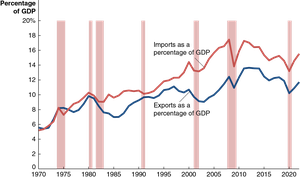
Key Point: The fraction of U.S. GDP accounted for by imports and exports has risen, highlighting the growing importance of international trade.
Comparative Advantage in International Trade
Comparative advantage is the ability of an individual, firm, or country to produce a good or service at a lower opportunity cost than competitors. This concept is central to understanding why countries trade and how they benefit from trade.
Opportunity cost: The highest-valued alternative that must be given up to engage in an activity.
Absolute advantage: The ability to produce more of a good or service than competitors using the same amount of resources.
Even if one country has an absolute advantage in producing all goods, both countries can benefit from trade if they specialize according to their comparative advantage.
How Countries Gain From International Trade
When countries specialize in goods for which they have a comparative advantage and trade, total production and consumption increase. The terms of trade determine the ratio at which countries exchange goods, and both parties benefit if the terms are better than their opportunity costs.
Autarky: A situation in which a country does not trade with other countries.
Terms of trade: The ratio at which a country can trade its exports for imports from other countries.
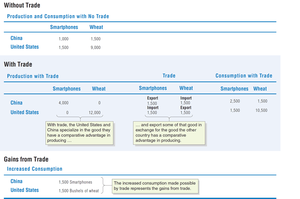
Example: If China specializes in smartphones and the U.S. in wheat, both countries can trade to consume more of both goods than they could in autarky.
Who Gains and Who Loses from U.S. Trade With China?
Trade between the U.S. and China has grown rapidly, especially after China adopted market reforms and joined the World Trade Organization. While consumers and firms benefit from lower prices and greater variety, some domestic industries and workers face increased competition.
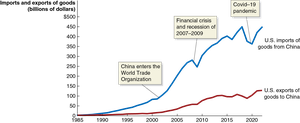
Key Point: U.S. imports from China have increased much more rapidly than exports to China, benefiting consumers but challenging some U.S. manufacturers.
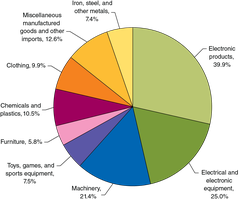
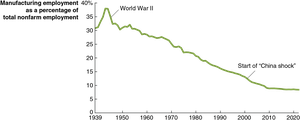
Example: Lower-income consumers benefit from cheaper imported goods, while U.S. manufacturing employment has declined, especially since the "China shock."
Sources of Comparative Advantage
Comparative advantage can arise from several sources:
Climate and natural resources: Some countries are better suited for certain types of production (e.g., bananas in Costa Rica, wheat in the U.S.).
Relative abundance of labor and capital: Differences in workforce skills and infrastructure (e.g., China has many low-skilled workers, U.S. has more high-skilled workers).
Technological differences: Variations in product and process technologies (e.g., U.S. excels in product innovation, Japan in process improvement).
External economies: Cost reductions from industry size (e.g., Silicon Valley, Hollywood).
Government Policies That Restrict International Trade
Trade Restrictions and Their Effects
Governments often restrict trade to protect domestic industries, using tariffs, quotas, and voluntary export restraints. These policies can benefit domestic producers but usually harm consumers and reduce overall economic surplus.
Tariffs: Taxes on imports.
Quotas: Numerical limits on imports.
Voluntary export restraints (VERs): Negotiated limits on exports.
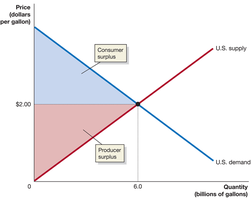
Example: In autarky, all domestic consumption is met by domestic production, with consumer and producer surplus determined by the equilibrium price.
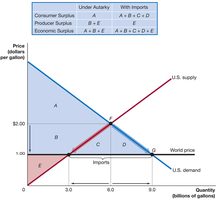
Example: Allowing imports lowers the price, increases consumer surplus, decreases producer surplus, and raises overall economic surplus.
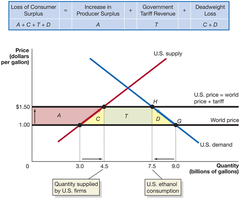
Example: Imposing a tariff raises the price, increases producer surplus and government revenue, but reduces consumer surplus and creates deadweight loss.
Import Quotas: The U.S. Sugar Market
Quotas restrict imports, raising domestic prices and benefiting domestic producers at the expense of consumers. Foreign producers may also benefit if they can sell at the higher domestic price.
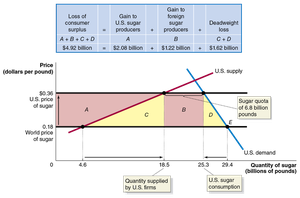
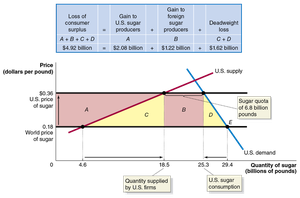
Example: The U.S. sugar quota increases producer surplus for U.S. firms and foreign producers, but reduces consumer surplus and creates deadweight loss.
Costs to Society from Import Restrictions
Import restrictions are often justified as a way to save domestic jobs, but the cost per job saved is typically very high. These policies can also reduce jobs in other industries by raising prices and reducing consumer spending.
Example: Shoe import tariffs cost $300,000 per job per year; tire tariffs cost $900,000 per job per year.
Removing tariffs and quotas unilaterally can benefit the economy, even if other countries do not reciprocate.
Other Barriers to Trade
Health, safety, and national security concerns can also lead to trade restrictions. These barriers may be justified in some cases, but often serve as protectionist measures.
Example: Restrictions on imports of personal protective equipment during pandemics.
The Debate over Trade Policies and Globalization
Trade Agreements and Organizations
Trade agreements and organizations like the World Trade Organization (WTO) have played a key role in reducing trade barriers and promoting globalization. The WTO oversees international trade agreements and provides dispute resolution mechanisms.
Globalization: The process of countries becoming more open to foreign trade and investment.
World Trade Organization (WTO): An international organization that oversees trade agreements.
Arguments Against Free Trade
Opposition to free trade comes from concerns about job losses, wage protection, cultural changes, and national security. Protectionism is the use of trade barriers to shield domestic firms from foreign competition.
Protectionism: The use of trade barriers to shield domestic firms from foreign competition.
Infant industry argument: New industries may need temporary protection to become competitive.
Trade and Climate Change
Some countries have considered tariffs to address environmental concerns, such as carbon border adjustment mechanisms (CBAMs) for steel. However, these policies are controversial and may lead to retaliatory tariffs.
Example: The European Union announced a CBAM on some products in 2022.
Dumping and Trade Policy
Dumping refers to selling a product below its cost of production. The WTO allows countries to impose restrictions if dumping is suspected, but determining true production costs is challenging.
Dumping: Selling a product for a price below its cost of production.
Positive vs. Normative Analysis in Trade Policy
Positive analysis describes "what is," while normative analysis reflects "what ought to be." Trade policy debates often involve normative judgments about values and morals.
Political Economy and Trade Restrictions
The costs of trade restrictions are spread across many consumers, while the benefits are concentrated among a few producers. This makes it difficult to build political support for removing restrictions.
Example: The U.S. sugar quota costs consumers $4.92 billion per year but benefits producers by $2.08 billion.
Building Bridges Versus Walls
Rather than protecting jobs through trade barriers, economists suggest compensating those affected by trade with retraining programs and tax credits for skill development. This approach aims to share the gains from increased economic efficiency.
Example: Funding for retraining and tax credits for firms investing in worker skills.
