 Back
BackComparative Advantage and the Gains from International Trade: Study Notes
Study Guide - Smart Notes
 Tailored notes based on your materials, expanded with key definitions, examples, and context.
Comparative Advantage and the Gains from International Trade
The United States in the International Economy
International trade has become increasingly important to the U.S. economy over the past several decades. Lower shipping, transportation, and communication costs, along with policy changes, have facilitated this growth. Traditionally, countries imposed high tariffs to protect domestic industries, but this also led to reciprocal taxes on exports.
Tariff: A tax imposed by a government on imports.
Imports: Goods and services bought domestically but produced in other countries.
Exports: Goods and services produced domestically but sold in other countries.
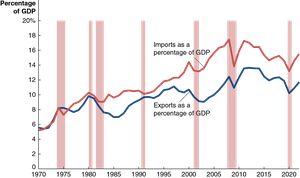
Example: The U.S. has seen imports and exports rise as a fraction of GDP, especially before the Great Recession of 2007-2009.
Comparative Advantage in International Trade
Countries specialize and trade because of comparative advantage, which is the ability to produce a good or service at a lower opportunity cost than competitors. This concept is central to understanding why trade can benefit all participating nations.
Comparative advantage: The ability to produce a good at a lower opportunity cost than others.
Opportunity cost: The highest-valued alternative that must be given up to engage in an activity.
Absolute advantage: The ability to produce more of a good or service than competitors using the same amount of resources.
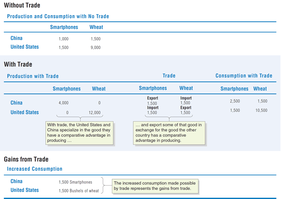
Example: Even if the U.S. is more productive than China in both smartphones and wheat, trade can still be mutually beneficial if each country specializes according to its comparative advantage.
How Countries Gain From International Trade
Trade allows countries to specialize in goods where they have a comparative advantage, leading to increased total output and consumption. The terms of trade determine the exchange rate for goods between countries, ensuring mutual benefit.
Autarky: A situation in which a country does not trade with other countries.
Terms of trade: The ratio at which a country can trade its exports for imports from other countries.
Example: If China specializes in smartphones and the U.S. in wheat, both countries can consume more of both goods through trade than they could in autarky.
Who Gains and Who Loses from International Trade?
While trade increases national welfare, it can negatively impact specific industries and workers. For example, U.S. manufacturing firms and their workers may lose out due to increased competition from imports, while consumers benefit from lower prices and greater variety.
Protectionist measures: Policies like tariffs and quotas designed to shield domestic industries from foreign competition.

Sources of Comparative Advantage
Comparative advantage can arise from several factors:
Climate and natural resources: Some countries are better suited for certain types of production (e.g., bananas in Costa Rica).
Relative abundance of labor and capital: Differences in workforce skills and infrastructure.
Technological differences: Variations in product and process technologies.
External economies: Cost reductions from industry size (e.g., Silicon Valley).
Government Policies That Restrict International Trade
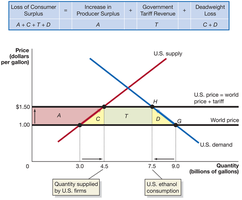
Governments often restrict trade to protect domestic industries, even when those industries lack comparative advantage. Common policies include tariffs, quotas, and voluntary export restraints.
Tariffs: Taxes on imports.
Quotas: Numerical limits on imports.
Voluntary export restraints (VERs): Negotiated limits on exports.
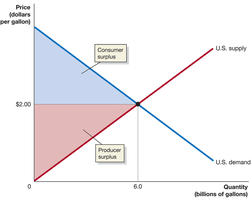
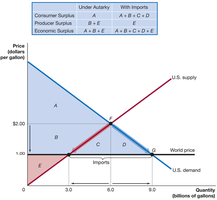
Example: The U.S. market for ethanol under autarky versus free trade shows how consumer and producer surplus change with trade.
Import Quotas and Their Effects
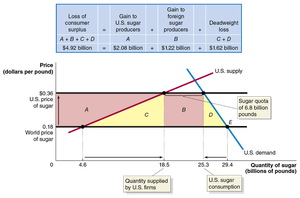
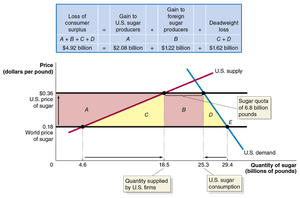
Quotas restrict imports, raising domestic prices and benefiting domestic producers at the expense of consumers. Foreign producers may also benefit if they can sell at higher prices, but overall economic efficiency declines due to deadweight loss.
Tariffs and Their Effects: Rice Market Example
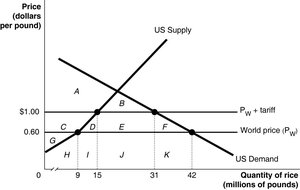
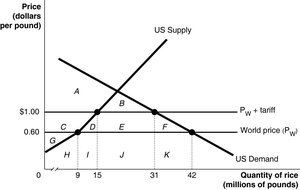
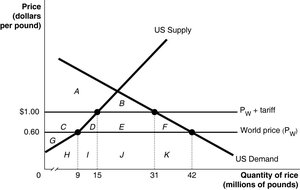
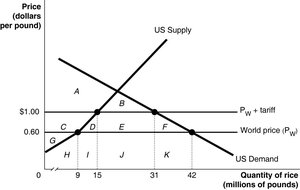
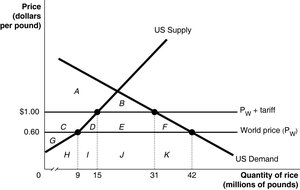
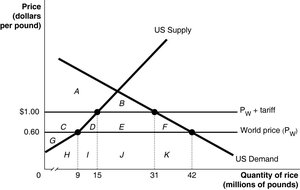
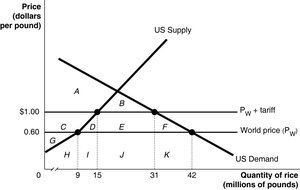
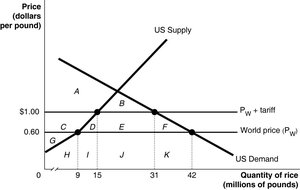
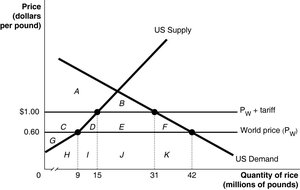
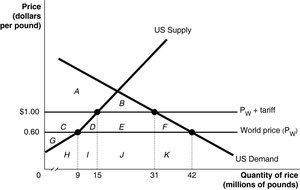
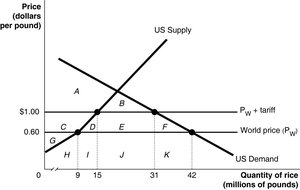
Tariffs on rice imports raise domestic prices, reduce consumption, and increase domestic production. The loss in consumer surplus and gain in producer surplus can be illustrated using supply and demand graphs.







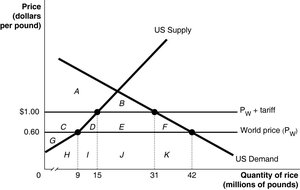
Costs to Society From Maintaining Import Restrictions
Import restrictions are often justified as a way to preserve domestic jobs, but the cost to consumers is typically much higher than the benefit to producers. For example, sugar quotas cost U.S. consumers billions annually, while benefiting a small group of producers.
The Debate over Trade Policies and Globalization
Trade agreements like GATT and the WTO have promoted freer trade globally. However, opposition persists due to concerns about job losses, wage protection, cultural changes, and national security. Economists generally favor free trade, but recognize that some individuals are worse off.
Globalization: The process of countries becoming more open to foreign trade and investment.
Protectionism: The use of trade barriers to shield domestic firms from foreign competition.
World Trade Organization (WTO): An international organization overseeing trade agreements and dispute resolution.
Trade and Climate Change
Recent debates include the use of tariffs to address environmental concerns, such as carbon border adjustment mechanisms. These policies aim to level the playing field for domestic producers facing stricter regulations, but may provoke retaliation and raise prices.
Dumping and Trade Restrictions
Dumping refers to selling products below their cost of production, often leading to trade restrictions. However, determining true production costs is challenging, and such practices may simply reflect normal business strategies.
Political Economy and Trade Restrictions
The costs of trade restrictions are spread across many consumers, while benefits are concentrated among a few producers. This dynamic makes it difficult to eliminate tariffs and quotas, despite their overall negative impact on economic efficiency.
Building Bridges Versus Walls
Rather than protecting industries through trade barriers, economists suggest compensating those negatively affected by trade, such as through retraining programs and tax credits for skill development.
Summary Table: Gains from Trade
Country | Smartphones | Wheat |
|---|---|---|
China | 1,500 Smartphones | |
United States | 1,500 Bushels of wheat |
Example: The increased consumption made possible by trade represents the gains from trade.
Key Equations
Opportunity Cost:
Economic Surplus:
Deadweight Loss from Tariff:
Conclusion
International trade, guided by comparative advantage, increases overall economic welfare but can create winners and losers within countries. Understanding the effects of trade policies, tariffs, and quotas is essential for evaluating their impact on efficiency and equity.
