 Back
BackCh.10 Consumer Choice and Behavioral Economics: Utility, Demand, and Decision-Making
Study Guide - Smart Notes
 Tailored notes based on your materials, expanded with key definitions, examples, and context.
Consumer Choice and Behavioral Economics
Utility and Consumer Decision Making
Understanding how consumers make choices is central to microeconomics. Economists use the concept of utility to describe the satisfaction or happiness derived from consuming goods and services. Consumers are assumed to be rational, aiming to maximize their total utility given their limited resources (income).
Utility: The enjoyment or satisfaction received from consuming goods and services.
Marginal Utility (MU): The additional utility gained from consuming one more unit of a good or service.
Law of Diminishing Marginal Utility: As more of a good is consumed, the additional satisfaction from each extra unit decreases.
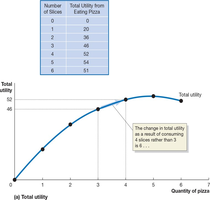
Budget Constraint: The limited amount of income available to spend on goods and services restricts consumer choices. Consumers allocate their resources to maximize utility, considering the marginal utility per dollar spent on each good:
Marginal Utility per Dollar = Marginal Utility of Good / Price of Good
To maximize utility, consumers should:
Equalize the marginal utility per dollar spent across all goods.
Exhaust their budget (spend all available income).
Rule of Equal Marginal Utility per Dollar Spent:
where is marginal utility and is price for goods A and B.
Income and Substitution Effects
When the price of a good changes, two effects influence consumer choice:
Income Effect: A price decrease increases purchasing power, allowing more consumption (for normal goods).
Substitution Effect: A price decrease makes the good relatively cheaper, leading consumers to substitute toward it.
For normal goods, both effects increase quantity demanded when price falls. For inferior goods, the income effect may reduce quantity demanded, but the substitution effect usually dominates.
Where Demand Curves Come From
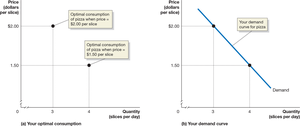
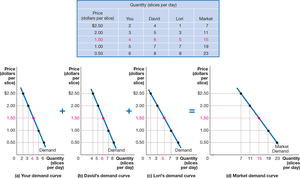
The law of demand states that as the price of a product falls, the quantity demanded increases. This can be explained by the income and substitution effects. Individual demand curves can be derived from utility-maximizing behavior, and market demand curves are the horizontal sum of individual demand curves.
Giffen Goods: In rare cases, a good may have an upward-sloping demand curve if it is an inferior good that constitutes a large portion of the consumer's budget and the income effect outweighs the substitution effect.
Social Influences on Decision Making
Consumer choices are often influenced by social factors, which standard economic models may overlook. These include:
Celebrity Endorsements: Consumers may be influenced by celebrities' preferences.
Network Externalities: The usefulness of a product increases as more people use it (e.g., social media platforms).
Fairness: People value fairness and may make choices that are not strictly self-interested, such as tipping or supporting fair pricing policies.
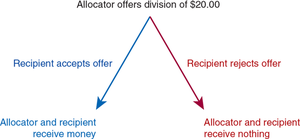
Experimental economics uses laboratory experiments to study real-world decision-making, such as the ultimatum game, which reveals that people often reject unfair offers even at a cost to themselves.
Behavioral Economics: Do People Make Rational Choices?
Behavioral economics studies situations where people do not act as traditional rational agents. Common mistakes include:
Ignoring Nonmonetary Opportunity Costs: People may undervalue time or effort compared to money.
Failing to Ignore Sunk Costs: Decisions are influenced by costs that cannot be recovered, even though they should be ignored.
Being Unrealistic about Future Behavior: People may overestimate their ability to follow through on intentions (e.g., quitting smoking).
Endowment Effect: People value items they own more than identical items they do not own, leading to inconsistent buying and selling decisions.
Nudges: Small changes in choice architecture (such as default options) can significantly influence behavior, aligning short-term actions with long-term goals.
Rules of Thumb and Anchoring: Consumers often use simple decision rules or are influenced by irrelevant information (anchors) when making choices.
Appendix: Indifference Curves and Budget Lines
Indifference curves and budget lines provide a graphical analysis of consumer choice.
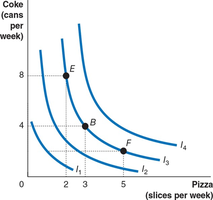
Indifference Curve: Shows all combinations of two goods that provide the same utility to the consumer.
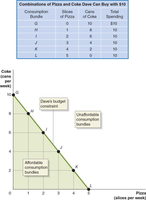
Budget Line: Represents all combinations of goods that can be purchased with a given income and prices.
Key properties:
Indifference curves are downward sloping and convex to the origin (diminishing marginal rate of substitution).
Indifference curves cannot cross.
The optimal consumption bundle is where the highest indifference curve is tangent to the budget line.
Marginal Rate of Substitution (MRS): The rate at which a consumer is willing to trade one good for another, keeping utility constant. At the optimum:
Thus, the rule of equal marginal utility per dollar spent is derived from the tangency condition between the indifference curve and the budget line.
Concept | Definition |
|---|---|
Utility | Satisfaction from consumption |
Marginal Utility | Change in utility from one more unit |
Budget Constraint | Income limit on spending |
Indifference Curve | Combinations of goods with equal utility |
Marginal Rate of Substitution | Rate of trade-off between goods |
Income Effect | Change in quantity demanded from change in purchasing power |
Substitution Effect | Change in quantity demanded from change in relative price |
Example: If pizza costs $2 per slice and Coke $1 per can, and a consumer has $10, the optimal bundle is where the marginal utility per dollar is equalized and the budget is exhausted. If the price of pizza falls, the budget line rotates outward, and the consumer can reach a higher indifference curve, increasing pizza consumption.
Additional info: The appendix also covers how changes in income and prices shift the budget constraint and affect optimal consumption, reinforcing the connection between utility maximization and demand curves.
