 Back
BackLecture 2: Economic Surplus and Market Efficiency: Microeconomics Study Notes
Study Guide - Smart Notes
 Tailored notes based on your materials, expanded with key definitions, examples, and context.
Economic Surplus and Market Efficiency
Introduction to Economic Surplus and Efficiency
Economic surplus and efficiency are central concepts in microeconomics, used to evaluate the benefits and costs of market outcomes. Economic surplus measures the net benefits to society from the production and consumption of goods, while economic efficiency refers to the allocation of resources that maximizes this surplus.
Economic surplus: The total benefits of a decision minus the total costs, regardless of who receives them.
the economic surplus you get from buying something (it's like the extra happiness you get from buying something)
Economic efficiency: An outcome is efficient if it generates the largest possible economic surplus.
Efficient outcome: The allocation that yields the maximum economic surplus.
Note: Efficiency is not always synonymous with fairness or popularity; it is a measure of total net benefit, not distribution.
Measuring Economic Surplus
Consumer Surplus
Consumer surplus is the economic surplus gained by buyers in a market. It is the difference between what consumers are willing to pay (marginal benefit) and what they actually pay (price).
Formula: Consumer surplus = Marginal benefit – Price
Interpretation: Measures the net benefit to consumers from market transactions.
Graphical representation: The area under the demand curve and above the market price, up to the quantity purchased.
Calculation (for a linear demand curve):
Example: If you are willing to pay $200 for Air Jordans and the price is $180, your consumer surplus is $20.

Producer Surplus
Producer surplus is the economic surplus gained by sellers. It is the difference between the price received and the marginal cost of production.
the area below the supply curve
Formula: Producer surplus = Price – Marginal cost
Interpretation: Measures the net benefit to producers from market transactions.
Graphical representation: The area above the supply curve and below the market price, up to the quantity sold.
Calculation (for a linear supply curve):
Example: If a seller's marginal cost is $10 and the market price is $25, the producer surplus is $15.
Total Economic Surplus
Total economic surplus is the sum of consumer and producer surplus. It represents the total net benefit to society from market transactions.
Formula: Economic surplus = Consumer surplus + Producer surplus
Graphical representation: The area between the demand and supply curves, up to the quantity traded.
Market Efficiency
Conditions for Market Efficiency
Markets are efficient when they allocate resources such that:
Goods are produced by the lowest-cost producers (efficient production).
Goods are consumed by those who value them most (efficient allocation).
The quantity produced maximizes total economic surplus (efmficient quantity).
The rational rule for markets is to produce until marginal benefit equals marginal cost:
Market Equilibrium and Efficiency
In a perfectly competitive market, equilibrium occurs where supply equals demand. At this point, economic surplus is maximized, and the allocation is efficient.
Consumer surplus is maximized under the demand curve above the price.
Producer surplus is maximized above the supply curve below the price.
Deadweight Loss and Market Failure
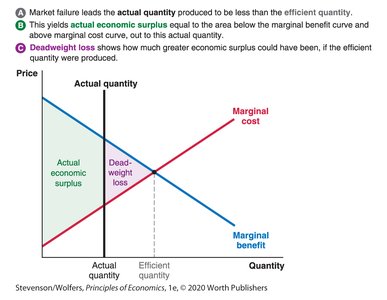
Market failures occur when the market does not achieve efficiency, often due to market power, externalities, information asymmetries, irrational behavior, or government intervention. Deadweight loss measures the reduction in economic surplus due to inefficiency.
Deadweight loss: The loss in total surplus that occurs when the quantity traded is less than or greater than the efficient quantity.

The Invisible Hand
Adam Smith's concept of the "invisible hand" describes how individuals pursuing their own self-interest can lead to efficient market outcomes, even if no one intends to achieve efficiency.

as opposed to the hand of the government that tells you want to do. letting people decided for themselves can lead to better economic outcomes
Critiques of Economic Efficiency
Distributional Concerns
Efficiency does not guarantee fairness. Market outcomes may be efficient but highly unequal. Equity is concerned with how the economic "pie" is divided, while efficiency is about the size of the pie.
Winners rarely compensate losers in practice.
Policy should consider both efficiency and equity.
Ex: professor vs elon at a taylor swift concert
prof willingness to pay might lower even though he might want it more than elon (because elon has more money even if he cares less)
The Wealthy Person Problem
Willingness to pay reflects both preferences and ability to pay. This can lead to outcomes where those with more resources receive goods, even if others would benefit more.
Efficiency may allocate goods to those with higher ability to pay, not necessarily those who value them most in utility terms.
Ex: professor vs elon at a taylor swift concert prof willingness to pay might lower even though he might want it more than elon (because elon has more money even if he cares less )
how much they care does not reflect willingness to pay because money plays an important role in it
Process vs. Outcome
Efficiency focuses on outcomes, not the fairness of the process. Some processes may be considered unjust, even if they lead to efficient outcomes.
Other ethical frameworks may prioritize process over outcomes.
Positive vs. Normative Economics
Economic analysis distinguishes between positive (what is) and normative (what ought to be) statements.
Positive analysis (more empirical): Describes and predicts the effects of policies without value judgments. done by using economic tools
Normative analysis (more theorical): Involves value judgments about which outcomes are better. most economists will follow this analysis
Key Takeaways
Economic surplus measures the net benefits of market transactions.
Market efficiency is achieved when economic surplus is maximized.
Deadweight loss represents the cost of market inefficiency.
Efficiency is important but not the only criterion for evaluating market outcomes; equity and process also matter.
