 Back
Back5. Efficiency and Equity in Competitive Markets
Study Guide - Smart Notes
 Tailored notes based on your materials, expanded with key definitions, examples, and context.
Efficiency and Equity in Microeconomics
Introduction to Efficiency and Equity
Efficiency and equity are central concepts in microeconomics, particularly in the analysis of market outcomes. Efficiency concerns the optimal allocation of resources to maximize total surplus, while equity addresses the fairness of the distribution of resources and outcomes.
Efficiency in Competitive Markets
Definition and Conditions for Efficiency
Efficiency means producing the maximum possible goods at the lowest possible cost and allocating goods to those who value them the most.
An allocation is efficient if it maximizes total surplus (the sum of consumer and producer surplus).
Efficiency requires:
Producing the socially optimal amount: No increase or decrease in quantity can increase total surplus.
Minimizing the cost of production: Goods are produced by the lowest-cost producers.
Allocating goods to those who value them most: Buyers with the highest willingness to pay receive the goods.
Mathematically, total surplus is given by:
Marginal Benefit and Marginal Cost
In a competitive equilibrium, marginal social benefit (MSB) equals marginal social cost (MSC) if there are no externalities.
Each seller produces until P = MC (price equals marginal cost).
Each buyer purchases until WTP = P (willingness to pay equals price).
Example: Efficient Allocation
Consider two buyers (Amy and Bob) and two sellers (Chris and Diana) with the following marginal benefits (MB) and marginal costs (MC):
MB (Amy) | MB (Bob) | MC (Chris) | MC (Diana) | |
|---|---|---|---|---|
Unit 1 | $10 | $9 | $1 | $3 |
Unit 2 | $4 | $7 | $2 | $5 |
Unit 3 | $0 | $0 | $6 | $8 |
The efficient allocation maximizes total surplus by matching the highest MB with the lowest MC for each unit.
Graphical Representation of Surplus
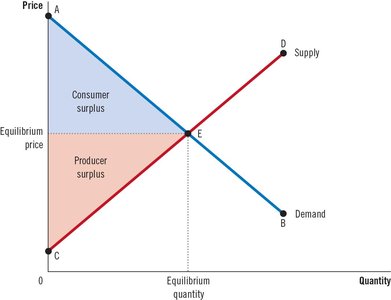
The areas under the demand and above the supply curves up to the equilibrium quantity represent consumer and producer surplus, respectively.
Market Allocation and Efficiency
Competitive markets, in the absence of externalities, allocate resources efficiently across all markets.
This is known as the "invisible hand" principle, where self-interested actions lead to socially optimal outcomes.
Consumer and Producer Surplus
Consumer Surplus
Consumer surplus is the difference between what consumers are willing to pay and what they actually pay, summed over all units bought.
Graphically, it is the area below the demand curve and above the market price, up to the equilibrium quantity.
Producer Surplus
Producer surplus is the difference between the market price and the marginal cost, summed over all units produced.
Graphically, it is the area above the supply curve and below the market price, up to the equilibrium quantity.
Calculating Surplus: Example
Suppose Amy is willing to pay $10 for the first unit, and Chris's cost is $1. The surplus from this unit is $9. This process is repeated for each unit to find the total surplus.
Applications and Limitations of Market Efficiency
Role of Competitive Markets
Competitive markets efficiently allocate resources by using prices as signals and incentives.
Freely floating prices ensure that goods go to those who value them most and are produced by those who can do so at least cost.

Limitations: Market Failures
Efficiency may not be achieved if there are externalities (e.g., pollution), public goods, or information asymmetries.
In such cases, government intervention may be necessary to improve outcomes.

Central Planning vs. Market Economies
Central planning often fails to allocate resources efficiently due to lack of information and incentives.
Market economies use prices to convey information and provide incentives for efficiency.
Government Intervention
Governments may intervene to:
Protect property rights and enforce laws
Promote competition (antitrust laws)
Address externalities (e.g., pollution control, education subsidies)
Regulate in cases of information asymmetry (e.g., food and drug safety)
Provide public goods
Promote equity through social welfare programs
Equity and Fairness
Types of Fairness
End-of-state fairness: Focuses on the fairness of outcomes (e.g., income equality). Drawback: May reduce incentives to work hard.
Procedural fairness: Focuses on the fairness of the rules (e.g., equal opportunity, voluntary exchange). Drawback: May not compensate those with low endowments.
Fairness in Competitive Markets
Competitive markets are fair according to procedural fairness: everyone faces the same prices and voluntary exchange is ensured.
However, they may not address inequalities in initial endowments.
Practice Problems and Applications
Shifts in Supply and Demand
Changes in supply or demand affect consumer and producer surplus.
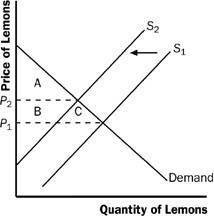
For example, a decrease in supply (e.g., due to a freeze in the lemon crop) raises prices and reduces consumer surplus

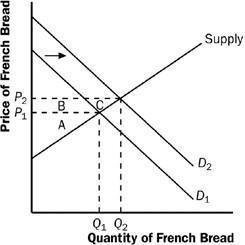
An increase in demand (e.g., for French bread) raises both price and producer surplus.
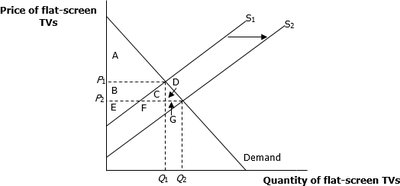
A decrease in production costs (e.g., for flat-screen TVs) shifts supply to the right, increasing total surplus. The distribution of gains depends on the elasticity of supply and demand.
Key Formulas
Consumer Surplus (CS):
Producer Surplus (PS):
Total Surplus (TS):
Summary Table: Efficiency and Equity
Concept | Definition | Key Condition |
|---|---|---|
Efficiency | Maximizing total surplus | MSB = MSC |
Consumer Surplus | WTP - Price | Area under demand, above price |
Producer Surplus | Price - MC | Area above supply, below price |
Equity | Fairness of allocation | End-of-state or procedural |
Key Takeaways
Competitive markets are efficient under certain conditions (no externalities, perfect information, etc.).
Efficiency does not guarantee equity; government intervention may be needed to address fairness.
Understanding surplus and market allocation is essential for analyzing policy impacts.
