 Back
Elasticity in Microeconomics: Price, Supply, Income, and Cross Elasticities
Study Guide - Smart Notes
 Tailored notes based on your materials, expanded with key definitions, examples, and context.
Elasticity
Introduction to Elasticity
Elasticity is a fundamental concept in microeconomics that measures the responsiveness of one variable to changes in another. In the context of markets, elasticity typically refers to how quantity demanded or supplied responds to changes in price, income, or the price of related goods.
Elasticity quantifies the sensitivity of economic agents to changes in market conditions.
It is crucial for understanding consumer behavior, producer decisions, and the effects of government policies.
Price Elasticity of Demand
Definition and Measurement
Price elasticity of demand measures how much the quantity demanded of a good responds to a change in its price.
Elastic demand: Quantity demanded changes significantly with price changes.
Inelastic demand: Quantity demanded changes little with price changes.
The formula for price elasticity of demand is: where is the change in quantity, is the average quantity, is the change in price, and is the average price.
Elasticity is reported as a positive number, even though the demand curve typically slopes downward (negative relationship).
Effects of Supply Shifts
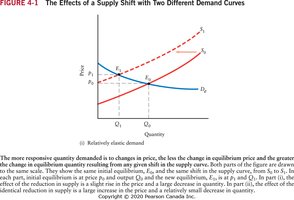
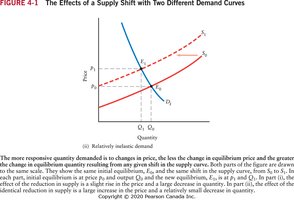
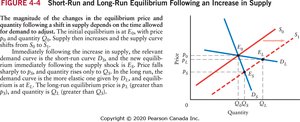
The elasticity of demand affects how equilibrium price and quantity change when the supply curve shifts.
With relatively elastic demand, a supply shift causes a smaller change in price and a larger change in quantity.
With relatively inelastic demand, a supply shift causes a larger change in price and a smaller change in quantity.
Elasticity Along a Linear Demand Curve
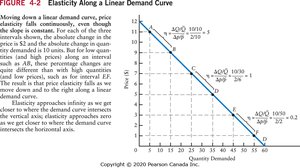
A linear demand curve has a constant slope but varying elasticity along its length.
Elasticity is higher at higher prices and lower quantities.
Elasticity decreases as you move down the curve to lower prices and higher quantities.
Constant Elasticity Demand Curves
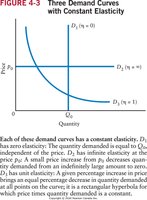
Some demand curves have constant elasticity throughout.
Perfectly inelastic demand: Quantity demanded does not change with price (vertical line).
Perfectly elastic demand: Quantity demanded changes infinitely with any price change (horizontal line).
Unit elastic demand: Percentage change in quantity equals percentage change in price.
Determinants of Price Elasticity of Demand
Several factors influence the elasticity of demand:
Availability of substitutes: More substitutes make demand more elastic.
Definition of the product: Narrowly defined products are more elastic than broadly defined ones.
Importance in budget: Goods that take up a larger share of the consumer's budget are more elastic.
Time horizon: Demand is more elastic in the long run as consumers have more time to adjust.
Elasticity and Total Expenditure
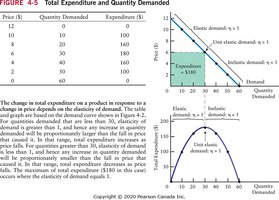
Total expenditure (or total revenue) is the product of price and quantity.
When demand is elastic, a price decrease increases total revenue.
When demand is inelastic, a price decrease decreases total revenue.
When demand is unit elastic, total revenue remains unchanged with price changes.
Price Elasticity of Supply
Definition and Measurement
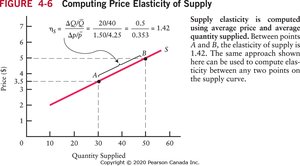
Price elasticity of supply measures how much the quantity supplied of a good responds to a change in its price.
It is denoted by .
The formula is:
Supply elasticity is computed using average price and average quantity supplied between two points on the supply curve.
Determinants of Supply Elasticity
Ease of substitution: The ability of producers to shift resources affects supply elasticity.
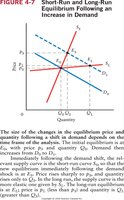
Time horizon: Supply is more elastic in the long run as producers can adjust capacity.
Elasticity and Excise Taxes
Tax Incidence and Elasticity
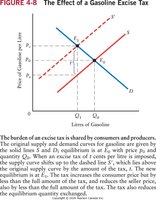
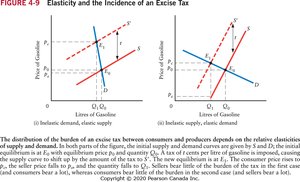
An excise tax is a tax on the sale of a particular product. The burden of the tax (tax incidence) is shared between consumers and producers depending on the relative elasticities of supply and demand.
If demand is inelastic and supply is elastic, consumers bear most of the tax burden.
If supply is inelastic and demand is elastic, producers bear most of the tax burden.
The price paid by consumers () and the price received by sellers () differ by the amount of the tax ().
Other Demand Elasticities
Income Elasticity of Demand
Income elasticity of demand measures how quantity demanded changes in response to changes in consumer income.
If , the good is a normal good.
If , the good is an inferior good.
For normal goods:
If , demand is income inelastic (necessities).
If , demand is income elastic (luxuries).
Inferior goods have negative income elasticity; demand decreases as income rises.
Cross Elasticity of Demand
Cross elasticity of demand measures how the quantity demanded of one good responds to changes in the price of another good.
If , goods X and Y are substitutes.
If , goods X and Y are complements.
An increase in the price of Y increases demand for X if they are substitutes, and decreases demand for X if they are complements.
Summary Table: Types of Elasticity
Elasticity Type | Formula | Interpretation |
|---|---|---|
Price Elasticity of Demand | Responsiveness of quantity demanded to price changes | |
Price Elasticity of Supply | Responsiveness of quantity supplied to price changes | |
Income Elasticity of Demand | Responsiveness of quantity demanded to income changes | |
Cross Elasticity of Demand | Responsiveness of demand for X to price changes in Y |
Additional info: Academic context and explanations have been expanded for clarity and completeness. All included images directly reinforce the adjacent explanations and are relevant to the microeconomics topics discussed.
