 Back
BackElasticity: Measuring Responsiveness in Microeconomics
Study Guide - Smart Notes
 Tailored notes based on your materials, expanded with key definitions, examples, and context.
Elasticity
Definition and Importance
Elasticity is a fundamental concept in microeconomics used to quantify how one variable responds to changes in another. It provides a more precise measure than simply observing the slope of demand or supply curves, as it uses percentage changes to account for differences in units and scale.
Elasticity: The responsiveness of one variable (such as quantity demanded or supplied) to changes in another variable (such as price).
General Formula:
Elasticity helps businesses and policymakers understand the effects of price changes, taxes, and other market interventions.
Price Elasticity of Demand
Concept and Calculation
Price elasticity of demand () measures how much the quantity demanded of a good responds to a change in its price. Because price and quantity move in opposite directions, $E_D$ is typically negative, but economists use the absolute value for interpretation.
Formula:
Elasticity is interpreted using absolute values:
Terminology
Elastic Demand: (quantity changes more than price)
Inelastic Demand: (quantity changes less than price)
Unit Elastic Demand: (quantity and price change equally)
Perfectly Elastic Demand: (quantity is infinitely responsive to price)
Perfectly Inelastic Demand: (quantity does not respond to price)
Midpoint Formula for Elasticity
To avoid inconsistencies in percentage change calculations, economists use the midpoint formula:
Midpoint Formula:
This formula uses averages to ensure symmetry between points A and B.
Slope and Elasticity
Relationship and Interpretation
While slope and elasticity are related, they are not the same. The slope depends on units, while elasticity is unit-free and compares percentage changes.
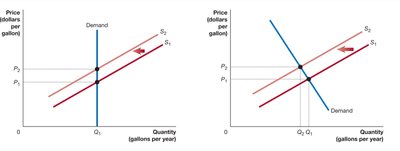
Flatter demand curves are more elastic; steeper curves are more inelastic.
A vertical demand curve is perfectly inelastic ().
A horizontal demand curve is perfectly elastic ().
Distinguishing Inelastic and Perfectly Inelastic Demand
Inelastic demand means quantity changes little with price, but not zero.
Perfectly inelastic demand means quantity does not change at all with price.
Example: Gasoline demand is inelastic, but not perfectly inelastic.
Determinants of Price Elasticity of Demand
Factors Influencing Elasticity
Several factors determine whether demand for a good is elastic or inelastic:
Availability of Substitutes: More substitutes lead to more elastic demand.
Passage of Time: Elasticity is higher in the long run as consumers adjust.
Luxury vs. Necessity: Luxuries have more elastic demand than necessities.
Definition of the Market: Narrowly defined markets have more elastic demand.
Share of Budget: Goods that take up a small portion of the budget are less elastic.
Price Elasticity of Demand and Total Revenue
Revenue Implications
Understanding elasticity helps businesses predict how changes in price affect total revenue:
Total Revenue:
If demand is elastic, lowering price increases revenue; raising price decreases revenue.
If demand is inelastic, raising price increases revenue; lowering price decreases revenue.
If demand is unit elastic, changes in price do not affect revenue.
Summary Table: Price Elasticity and Revenue
Elasticity | Price Increase | Price Decrease | Reason |
|---|---|---|---|
Elastic | Reduces revenue | Increases revenue | Quantity changes more than price |
Inelastic | Increases revenue | Reduces revenue | Quantity changes less than price |
Unit Elastic | No effect | No effect | Quantity and price change equally |
Cross-Price Elasticity of Demand
Definition and Application
Cross-price elasticity measures how the quantity demanded of one good responds to the price change of another good.
Formula:
Positive value: Goods are substitutes.
Negative value: Goods are complements.
Income Elasticity of Demand
Definition and Application
Income elasticity measures how the quantity demanded of a good responds to changes in income.
Formula:
Positive value: Normal goods (demand increases with income).
Negative value: Inferior goods (demand decreases with income).
Example: Elasticities of Alcoholic Beverages
Price elasticity of demand for beer: -0.30 (inelastic)
Cross-price elasticity between beer and wine: -0.83 (complements)
Cross-price elasticity between beer and spirits: -0.50 (complements)
Income elasticity for beer: 0.09 (normal good, necessity)
Price Elasticity of Supply
Definition and Calculation
Price elasticity of supply measures how much the quantity supplied responds to a change in price.
Formula:
Calculation methods are similar to those for demand (midpoint formula, etc.).
Determinants of Price Elasticity of Supply
Ability to Change Production: Firms' flexibility affects elasticity.
Time Period: Supply is more elastic in the long run as firms adjust production.
Example: Farmers cannot quickly increase grape production, so supply is inelastic in the short run but more elastic in the long run.
Polar Cases: Perfectly Elastic and Perfectly Inelastic Supply
Vertical supply curve: Perfectly inelastic ()
Horizontal supply curve: Perfectly elastic ()
Applications of Elasticity
Predicting Market Outcomes
Knowing the price elasticity of supply and demand helps predict how changes in demand or supply affect equilibrium price and quantity.
If supply is inelastic, a demand increase raises price significantly.
If supply is elastic, a demand increase raises price less.
Practice Questions
What assumption is the DC metro manager making about the price elasticity of demand for metro fares when increasing prices?
What does the US government hope the price elasticity of demand is for cigarettes when implementing a tax increase?
