 Back
BackEquilibrium and Elasticity: Microeconomics Study Notes
Study Guide - Smart Notes
 Tailored notes based on your materials, expanded with key definitions, examples, and context.
Market Equilibrium
Understanding Market Equilibrium
Market equilibrium occurs when the quantity demanded equals the quantity supplied at a particular price. This balance determines the market price and quantity for goods and services.
Equilibrium Price (Pe): The price at which demand and supply curves intersect.
Equilibrium Quantity (Qe): The quantity bought and sold at the equilibrium price.
Market Shocks: Any event (e.g., changes in interest rates) can shift demand or supply, creating excess demand or supply and leading to a new equilibrium.
Example: Lower interest rates shift the demand curve to the right, increasing both the equilibrium price and quantity.
Elasticity
Price Elasticity of Demand
Price elasticity of demand measures how much the quantity demanded of a good responds to changes in its price.
Formula:
Arc Elasticity (Midpoint Formula):
Elastic Demand (E > 1): Quantity demanded changes more than price; lowering price increases revenue.
Inelastic Demand (E < 1): Quantity demanded changes less than price; lowering price decreases revenue.
Unit Elastic (E = 1): Price changes cause no change in revenue.
Example: For pens, as price drops from E = \frac{100/150}{-1/5.50} = -3.67$
Factors Affecting Price Elasticity of Demand
Availability of Substitutes: More substitutes make demand more elastic.
Portion of Income: A higher portion spent increases elasticity.
Time Horizon: A longer time horizon allows for greater elasticity.
Cross Price Elasticity of Demand
Cross-price elasticity measures how the quantity demanded of one good responds to changes in the price of another good.
Formula:
Substitutes: (increase in price of Y increases demand for X)
Complements: (increase in price of Y decreases demand for X)
Income Elasticity of Demand
Income elasticity measures how the quantity demanded responds to changes in consumer income.
Formula:
Normal Goods: (demand increases as income rises)
Inferior Goods: (demand decreases as income rises)
Price Elasticity of Supply
Price elasticity of supply measures how much the quantity supplied responds to changes in price.
Formula:
Arc Elasticity:
Elastic Supply: Large response to price changes.
Inelastic Supply: Small response to price changes.
Tax Incidence and Market Equilibrium
Burden or Incidence of a Tax
Tax incidence refers to how the burden of a tax is shared between buyers and sellers.
Sales Tax: Modelled as an upward shift in the supply curve, increasing production costs.
Tax Burden Sharing: Depends on the relative elasticities of demand and supply.
More Elastic Demand: Consumers pay a smaller share of the tax.
More Inelastic Demand: Consumers pay a larger share of the tax.
Example: A 10% sales tax on televisions increases the price, but the full tax is not passed to consumers; the burden is shared.
Summary Table: Elasticity and Revenue for Pens
Elasticity and Revenue Table
Price (P) | Quantity | Elasticity | Revenue |
|---|---|---|---|
$6 | 100 | 3.67 | $600 |
$5 | 200 | 1.81 | $1000 |
$4 | 300 | 1.00 | $1200 |
$3 | 400 | 0.55 | $1200 |
$2 | 500 | 0.27 | $1000 |
$1 | 600 | 0.27 | $600 |
Additional info:
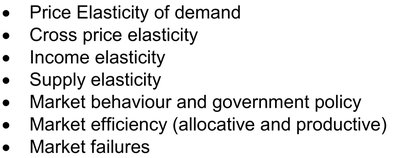
The image references market efficiency and failures, allocative and productive efficiency, and government policy, but these topics are not fully covered in the provided text. For exam prep, review Ch. 5, Ch. 12, and Ch. 16-18 for more detail on these topics.
