 Back
BackExternalities and Market Failure: Microeconomics Study Notes
Study Guide - Smart Notes
 Tailored notes based on your materials, expanded with key definitions, examples, and context.
Externalities and Market Failure
Introduction to Externalities
Externalities are a central concept in microeconomics, describing situations where the actions of individuals or firms have effects on others that are not reflected in market prices. These effects can be either positive or negative, and when they are not internalized, markets fail to achieve efficient outcomes.
Externality: A consequence of an economic activity experienced by unrelated third parties; it can be positive or negative.
Market Failure: Occurs when prices do not reflect the true societal costs and benefits, leading to inefficiency.
Negative Externalities
Negative externalities arise when an economic activity imposes costs on others that are not compensated or accounted for by the market.
Definition: An economic activity that negatively affects others, with these effects not captured by market prices.
Examples: Air pollution, smoking, traffic congestion.
Optimization Problem: Individuals may optimize their own costs and benefits but ignore the costs imposed on others.
Example: Smoking
Smoking imposes health costs on others and increases health insurance premiums for the wider population. 
Private decision-makers consider their own benefits and costs, but not the external costs.
Policy solutions include prohibiting smoking in public spaces and imposing heavy taxes on cigarettes.
Example: Pollution
An electricity company may dump pollution into a river, affecting beachgoers and nearby businesses such as microbreweries. 


The company considers only its private costs, not the external costs imposed on others.
The true cost should include both marginal cost (MC) and marginal external cost, forming the social marginal cost (SMC).
Graphical Representation
Market equilibrium is determined by private MC and demand.
Socially optimal equilibrium considers SMC, resulting in higher price and lower quantity.
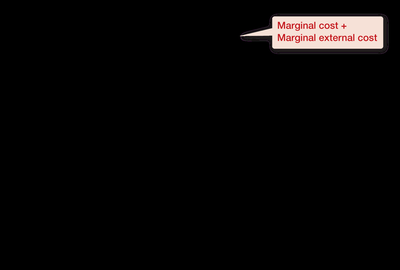
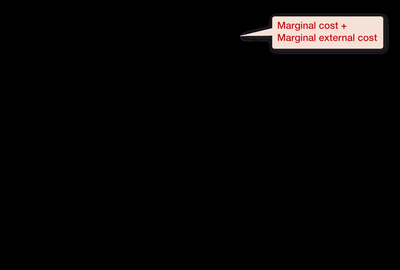
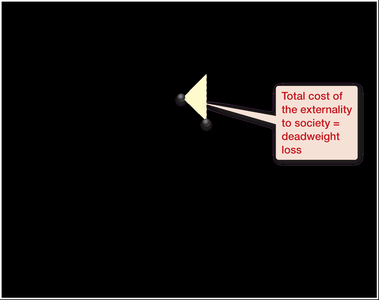
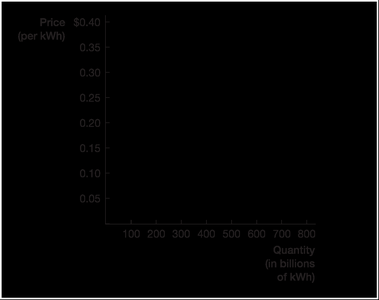
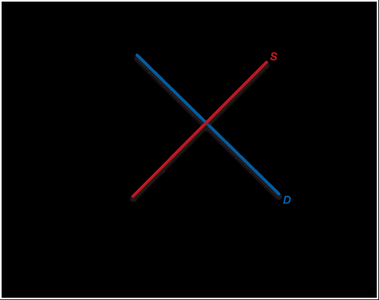
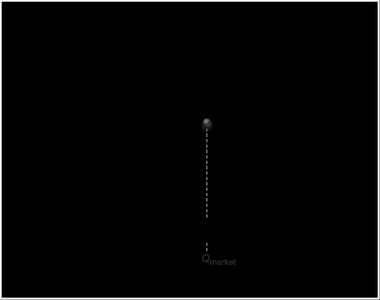
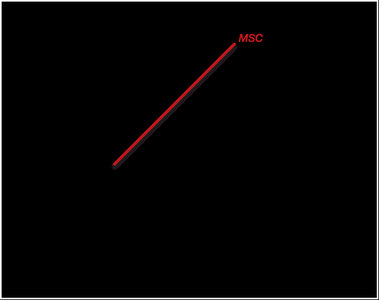
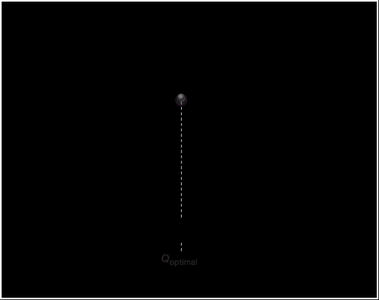
Deadweight Loss (DWL): The loss in efficiency due to externalities, represented by the area where social marginal cost exceeds willingness to pay (WTP).
Positive Externalities
Positive externalities occur when an economic activity benefits others, but these benefits are not captured by market prices.
Definition: An economic activity that positively affects others, with these effects not captured by market prices.
Examples: Education, flu shots, research and development.
Example: Flu Shots
Getting a flu shot protects not only the individual but also others by reducing the spread of germs. 
Individuals consider their own benefits and costs, but not the external benefits to others.
Policy solutions include providing free flu shots through health insurance or public programs.
Example: Education
Education provides private benefits to individuals and external benefits to society, such as increased tax revenue, decreased crime, and more informed citizens.
The optimal level of education should be higher than the market equilibrium.
The marginal social benefit (MSB) curve captures all benefits, both private and external.
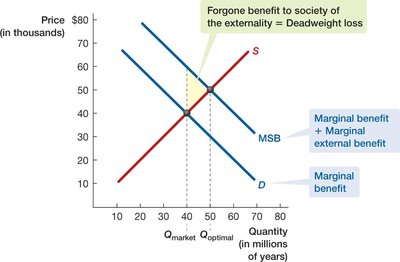
For units in the triangle, marginal private cost (MPC) is less than MSB, indicating underproduction in the market.
The forgone benefit to society is the deadweight loss from the externality.
Solutions to Externalities
The main goal of solutions is to internalize external costs and benefits, making them part of the decision-making process.
Private Solutions: Bargaining, social norms.
Government Solutions: Direct regulation, market-based policies (taxes and subsidies), cap and trade.
Private Solutions: Bargaining
Bargaining can lead to efficient outcomes if property rights are well-defined and transaction costs are low.
Coase Theorem: Private bargaining will result in efficient allocation of resources regardless of who holds property rights, provided transaction costs are low and property rights are clear.
Efficiency is achieved, but equity depends on the distribution of property rights.
Profits Per Day | No Filter | With Filter |
|---|---|---|
Polluter | $130 | $100 |
Brewery | $90 | $140 |
Outcome with filter installed maximizes social surplus ($240 vs. $220).
Private Solutions: Social Norms
Social norms can encourage individuals to internalize externalities, such as recycling or reducing pollution, due to social costs or moral incentives.
Not following social norms may lead to social punishment.
Government Solutions: Direct Regulation
Governments can mandate socially optimal quantities and prices, but this requires significant information and can be complex. 
Firms are paid their private marginal cost, and extra funds are used to compensate those negatively affected.
Government Solutions: Market-Based Policies
Taxes: Per unit tax on firms producing negative externalities shifts the supply curve up, incentivizing efficient outcomes.
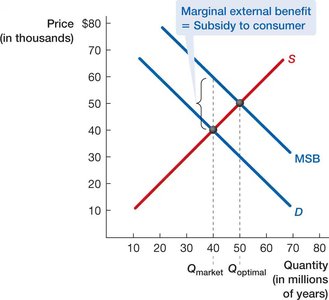
Subsidies: Per unit subsidy for buyers of goods with positive externalities shifts the demand curve up, incentivizing efficient outcomes.
Cap and Trade: Establishes a market for pollution permits, reducing informational burden and allowing firms with the lowest cost to reduce emissions to do so.
Key Formulas and Concepts
Social Marginal Cost (SMC):
Marginal Social Benefit (MSB):
Deadweight Loss (DWL): Area between SMC and WTP (or MSB and MPC) at market equilibrium.
Summary Table: Types of Externalities
Type | Effect | Examples | Policy Solution |
|---|---|---|---|
Negative Externality | Imposes cost on others | Pollution, smoking | Taxes, regulation, cap and trade |
Positive Externality | Benefits others | Education, flu shots | Subsidies, public provision |
Conclusion
Externalities are a fundamental cause of market failure in microeconomics. Understanding their nature and the available solutions is essential for designing policies that improve social welfare and achieve efficient outcomes. Key takeaway: Internalizing externalities—through private bargaining, social norms, or government intervention—is crucial for maximizing total surplus and achieving efficiency in markets.
