 Back
BackExternalities, Environmental Policy, and Public Goods: Microeconomics Study Notes
Study Guide - Smart Notes
 Tailored notes based on your materials, expanded with key definitions, examples, and context.
Chapter 5: Externalities, Environmental Policy, and Public Goods
5.1 Externalities and Economic Efficiency
Externalities are unintended side effects of economic activities that affect third parties not directly involved in the transaction. They can be either positive or negative and lead to market outcomes that are not economically efficient.
Externality: A benefit or cost that affects someone who is not directly involved in the production or consumption of a good or service.
Negative Externality: Imposes costs on others (e.g., pollution).
Positive Externality: Confers benefits on others (e.g., education).
Private Cost: Cost borne by the producer.
Social Cost: Total cost to society, including both private and external costs.
Private Benefit: Benefit received by the consumer.
Social Benefit: Total benefit to society, including both private and external benefits.
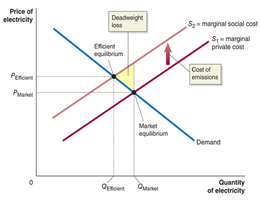
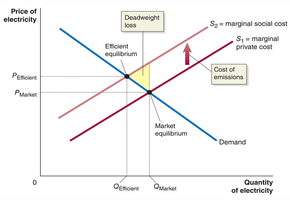
Example: Pollution from electricity production is a negative externality because it imposes costs on others not involved in the transaction.
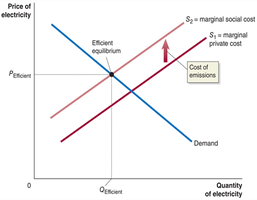
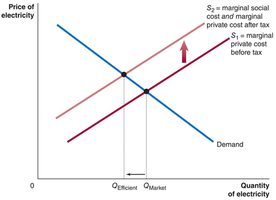
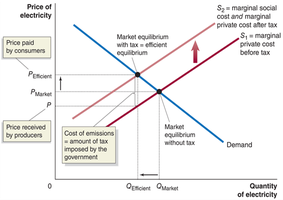
When negative externalities exist, the market equilibrium quantity is greater than the socially optimal quantity, resulting in deadweight loss.
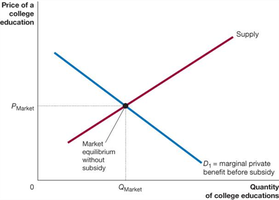
When positive externalities exist, the market equilibrium quantity is less than the socially optimal quantity, also resulting in deadweight loss.
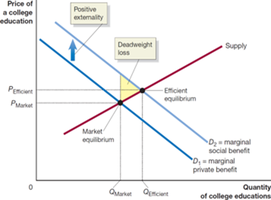
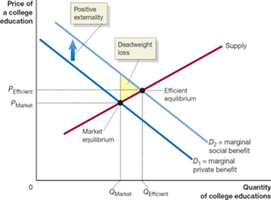
Market Failure: Occurs when the market fails to produce the efficient level of output due to externalities.
5.2 Private Solutions to Externalities: The Coase Theorem
The Coase Theorem suggests that if property rights are well-defined and transaction costs are low, private bargaining can lead to an efficient outcome regardless of who holds the rights.
Property Rights: Legal rights to use and transfer resources.
Coase Theorem: Private parties can solve externality problems through negotiation if property rights are assigned and transaction costs are low.
Transaction Costs: Costs of negotiating and enforcing agreements.
Example: A farmer and a paper mill sharing a stream can negotiate pollution reduction if property rights are clear.
Efficient pollution reduction occurs where the marginal benefit of reduction equals the marginal cost:
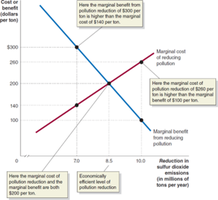
The net benefit to society from reducing pollution to the optimal level is the area between the marginal benefit and marginal cost curves.
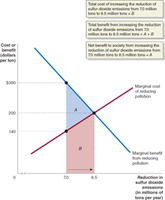
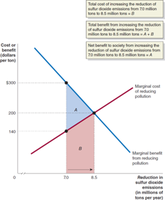
Additional info: The assignment of property rights does not affect the efficient outcome, but it does affect the distribution of costs and benefits.
5.3 Government Policies to Deal With Externalities
Governments can use taxes, subsidies, and regulations to correct market failures caused by externalities.
Pigovian Tax: A tax imposed to correct the effects of a negative externality.
Pigovian Subsidy: A subsidy to encourage activities with positive externalities.
Command-and-Control: Direct regulation, such as limits on emissions or required technology.
Tradable Emissions Allowances (Cap-and-Trade): Permits that can be bought and sold, allowing firms flexibility in meeting pollution targets.
Example: A tax equal to the external cost of pollution shifts the supply curve upward, reducing output to the efficient level.
Example: A subsidy for college education increases the quantity consumed to the efficient level.
Additional info: Pigovian taxes and subsidies are preferred by economists because they correct market failures while generating government revenue or reducing other taxes.
5.4 Four Categories of Goods
Goods can be categorized based on whether they are rival and/or excludable. This classification affects how efficiently markets provide these goods.
Rivalry: One person's consumption reduces the amount available for others.
Excludability: People can be prevented from using the good if they do not pay.
Type of Good | Rival? | Excludable? | Examples |
|---|---|---|---|
Private Good | Yes | Yes | Food, clothing |
Public Good | No | No | National defense, public parks |
Common Resource | Yes | No | Fish in the ocean, forests |
Quasi-Public Good | No | Yes | Toll roads, cable TV |
Efficient Provision: Markets provide private goods efficiently, but public goods and common resources are subject to free-rider and overuse problems, respectively.
Tragedy of the Commons: Overconsumption of common resources due to lack of property rights.
Solution: Assigning property rights, community norms, or government intervention (taxes, quotas, permits).
