 Back
Externalities, Environmental Policy, and Public Goods: Microeconomics Study Notes
Study Guide - Smart Notes
 Tailored notes based on your materials, expanded with key definitions, examples, and context.
Externalities, Environmental Policy, and Public Goods
5.1 Externalities and Economic Efficiency
Externalities are unintended side-effects of economic activities that affect third parties not directly involved in the transaction. They can be either positive or negative, and their presence leads to market inefficiency.
Externality: A benefit or cost that affects someone who is not directly involved in the production or consumption of a good or service.
Negative Externality: Occurs when the total cost of production is greater than the private cost. Example: Pollution from manufacturing.
Positive Externality: Occurs when the total benefit of consumption is greater than the private benefit. Example: Renovating a house increases neighborhood property values.
Private Costs: Costs borne by producers.
Social Costs: Total costs, including private and external costs.
Private Benefits: Benefits received by consumers.
Social Benefits: Total benefits, including private and external benefits.
Market Failure: When externalities cause the market equilibrium to deviate from the efficient quantity, resulting in deadweight loss.
Example: Pollution from electricity production imposes costs on society beyond those paid by producers, leading to overproduction and deadweight loss.
5.2 Private Solutions to Externalities: The Coase Theorem
The Coase theorem suggests that private bargaining can resolve externalities efficiently if property rights are well-defined and transaction costs are low.
Property Rights: The rights to exclusive use, buy, or sell property (tangible or intangible).
Coase Theorem: Private parties can solve externality problems through negotiation if property rights are assigned and transaction costs are low.
Transaction Costs: Costs incurred in negotiating and enforcing agreements.
Marginal Benefit vs. Marginal Cost: The efficient level of pollution reduction is where the marginal benefit equals the marginal cost.
Example: A farmer and a paper mill sharing a stream can negotiate pollution levels if property rights are clear.
Additional info: The theorem holds regardless of who holds the property rights, as long as negotiation is feasible.
5.3 Government Policies to Deal With Externalities
Government intervention can correct market inefficiencies caused by externalities through taxes, subsidies, and regulations.
Pigovian Taxes: Taxes imposed to internalize negative externalities, aligning private and social costs.
Pigovian Subsidies: Subsidies to encourage production or consumption of goods with positive externalities.
Command-and-Control: Government sets quantitative limits or requires specific technologies to reduce pollution.
Tradable Emissions Permits (Cap-and-Trade): Firms can buy and sell permits to emit pollutants, ensuring reduction at lowest cost.
Example: British Columbia's carbon tax reduces emissions and uses revenue to lower income taxes.
Additional info: Cap-and-trade systems have proven effective but require political support and careful design.
5.4 Four Categories of Goods
Goods are classified based on rivalry and excludability, which affect how efficiently markets provide them.
Rivalry: One person's consumption reduces availability for others.
Excludability: Non-payers can be prevented from consuming the good.
Excludable | Nonexcludable | |
|---|---|---|
Rival | Private Goods Examples: Big Macs, Running shoes | Common Resources Examples: Tuna in the ocean, Public pastureland |
Nonrival | Quasi-Public Goods Examples: Cable TV, Toll road | Public Goods Examples: National defense, Court system |
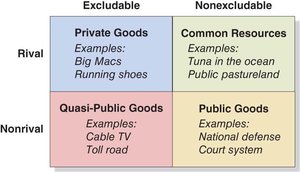
Private Goods: Rival and excludable; efficiently provided by markets.
Common Resources: Rival but nonexcludable; tend to be overused (tragedy of the commons).
Quasi-Public Goods: Nonrival but excludable; profit-maximization may exclude too many people.
Public Goods: Nonrival and nonexcludable; subject to free-rider problem.
Efficient Provision: Markets are efficient for private goods but not for public goods or common resources due to free-riding and overuse.
Example: National defense is a public good; tuna in the ocean is a common resource.
Constructing Demand Curves for Private and Public Goods
The method of aggregating individual preferences differs for private and public goods.
Private Goods: Add quantities demanded at each price (horizontal summation).
Public Goods: Add prices each consumer is willing to pay for each quantity (vertical summation).
Example: For hamburgers (private good), total demand at $4 is sum of individual quantities. For security guard services (public good), total willingness to pay at 10 hours is sum of individual prices.
Efficient Consumption of Common Resources
Common resources are often overused because individuals ignore external costs, leading to deadweight loss.
Tragedy of the Commons: Overuse of common resources due to lack of property rights.
Solutions: Community norms or legal restrictions (taxes, quotas, permits).
Example: Overharvesting wood from a public forest.
Additional info: Pigovian taxes can help internalize external costs when property rights cannot be enforced.
