 Back
Chapter 8 Study Guide
Study Guide - Smart Notes
 Tailored notes based on your materials, expanded with key definitions, examples, and context.
Firms, the Stock Market, and Corporate Governance
Types of Firms
Firms in the United States are legally categorized as sole proprietorships, partnerships, or corporations. Each structure has distinct characteristics regarding ownership, liability, and financial organization.
Sole Proprietorship: Owned by a single individual, not organized as a corporation. The owner has unlimited liability, meaning personal assets are at risk if the firm fails.
Partnership: Owned jointly by two or more persons, not organized as a corporation. Partners also have unlimited liability.
Corporation: A legal entity separate from its owners, providing limited liability. Owners (shareholders) are protected from losing more than their investment.
Limited liability makes corporations attractive for raising funds and investing, but they are more expensive to organize and may face double taxation (corporate profits and dividends).
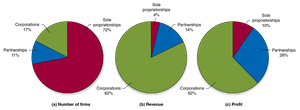
Economic activity is concentrated in corporations, even though sole proprietorships are more numerous.
Trends in New Business Formation
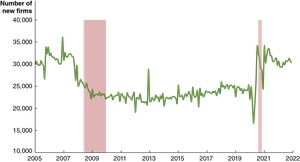
The number of new firms started in the U.S. fluctuates with economic conditions. After the Great Recession (2007-2009), new firm formation slowed, and it dropped further during the Covid-19 pandemic before rebounding.
Factors affecting new business formation include technological progress, government regulation, and entrepreneurial interest.
The pandemic led to a surge in entrepreneurship, as workers adapted to changing job markets.
Corporate Structure and Governance
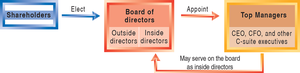
Corporations typically feature a separation of ownership from control. Shareholders (owners) elect a board of directors, which appoints top managers (e.g., CEO, CFO) to oversee daily operations.
Corporate governance: The structure and rules that determine how a corporation is managed and how decisions are made.
Principal-agent problem: Occurs when managers (agents) pursue their own interests rather than those of shareholders (principals).
Aligning incentives, such as paying managers with stock or stock options, can help mitigate this problem, but perfect alignment is rarely possible.
Multinational Corporations
Many corporations operate in multiple countries to avoid tariffs, access resources, reduce labor costs, manage exchange rate risks, and respond to competition.
Example: Tesla opened factories in China and Germany to expand global operations.
How Firms Raise Funds
Methods of Raising Funds
Small business owners can raise funds through:
Retained earnings: Reinvesting profits in the firm.
Recruiting additional owners: Increasing financial capital by adding partners or shareholders.
Borrowing: Obtaining loans from financial institutions or individuals.
External Funds: Indirect and Direct Finance
Indirect finance: Funds flow from savers to borrowers through financial intermediaries (e.g., banks).
Direct finance: Firms raise funds directly from investors via financial markets, issuing bonds or stocks.
Bonds
A bond is a financial security representing a loan. The firm promises to repay the principal at maturity and make periodic coupon (interest) payments.
Higher default risk requires higher coupon payments.
Stocks
Stocks represent partial ownership in a firm. Shareholders may receive dividends or benefit from capital gains if the stock's value increases.
Bonds are less risky than stocks because bondholders are repaid before shareholders.
Mutual Funds and Exchange-Traded Funds
Mutual funds: Actively managed portfolios; shares can only be sold back to the management company.
Exchange-traded funds (ETFs): Passively managed portfolios; shares can be traded among investors.
Stock and Bond Markets
After issuance, stocks and bonds are traded in financial markets. These markets provide liquidity and information about firms' prospects.
Stock prices reflect expectations about future profits.
Bond prices depend on coupon payments and perceived risk.
Stock Market Indexes
Stock market indexes (e.g., S&P 500) track average stock prices and are used to gauge market performance. Index values are relative to a base year.
Example: Peloton's Stock Price
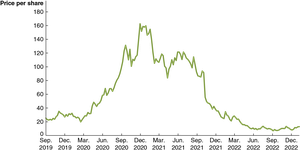
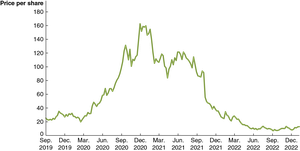
Peloton's share price fluctuated dramatically during the pandemic, reflecting changing investor expectations about future profits.
Using Financial Statements to Evaluate a Corporation
Financial Statements
Publicly owned firms must release financial statements using generally accepted accounting principles (GAAP). These statements help investors make informed decisions.
Income statement: Shows revenues, costs, and profit over a period (usually a year).
Balance sheet: Summarizes assets, liabilities, and net worth at a specific point in time.
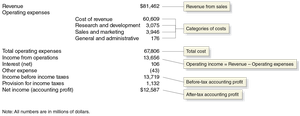
Income Statement Example: Tesla 2022
Tesla's income statement for 2022 shows revenue, operating expenses, and net income.
Accounting Profit vs. Economic Profit
Accounting profit: Revenue minus explicit costs (actual money spent).
Economic profit: Revenue minus both explicit and implicit costs (including opportunity costs).
Example: If a business owner could earn $5,500 working elsewhere, but earns $5,000 after explicit costs in their own business, their economic profit is -$500.
Problems in Corporate Governance
Accurate financial statements are essential for efficient resource allocation. Inaccurate statements can mislead investors and harm economic growth.
Regulations like the Sarbanes-Oxley Act and Dodd-Frank Act aim to increase transparency and reduce risk.
Appendix: Using Present Value
Present Value Concept
The present value of future funds is their value in today's dollars. The formula for present value is:
Where Future is the amount to be received in n years, and i is the interest rate.
Present Value of a Series of Payments
To calculate the present value of multiple payments, sum the present values of each payment:
Asset Pricing Using Present Value
The price of a financial asset (bond or stock) should equal the present value of expected future payments:
Bonds: Present value of coupon payments and principal repayment.
Stocks: Present value of expected dividend payments (often modeled as an infinite series).
Stock Price Formula (Constant Growth)
Where D is the current dividend, i is the required rate of return, and g is the growth rate of dividends.
Appendix: Income Statements and Balance Sheets
Income Statement
Shows a firm's revenue and costs for a given year. The difference is net income (after-tax accounting profit).
Balance Sheet
Summarizes a firm's financial position:
Net worth (stockholders' equity) is assets minus liabilities.
Current assets and liabilities are listed first.
Uses of Financial Statements
Financial statements allow comparison between firms, evaluation of profitability, and benchmarking. They are used by investors, lenders, regulators, and managers.
