 Back
BackFirms in Competitive Markets: Profit Maximization and Supply Decisions
Study Guide - Smart Notes
 Tailored notes based on your materials, expanded with key definitions, examples, and context.
Competitive Markets and Perfect Competition
Characteristics of a Competitive Market
A competitive market is defined by several key features that distinguish it from other market structures. In a perfectly competitive market:
There are many buyers and sellers.
Firms sell identical products.
Each buyer and seller is a price taker, meaning no individual can influence the market price.
Firms can freely enter or exit the market.
Revenue Concepts in Competitive Firms
Total, Average, and Marginal Revenue
Firms in competitive markets aim to maximize profit, which is the difference between total revenue and total cost.
Total Revenue (TR): The total income from sales, calculated as (Price times Quantity).
Average Revenue (AR): Revenue per unit sold, .
Marginal Revenue (MR): The additional revenue from selling one more unit, .
For competitive firms, and .
Profit Maximization
Profit Maximization Rule
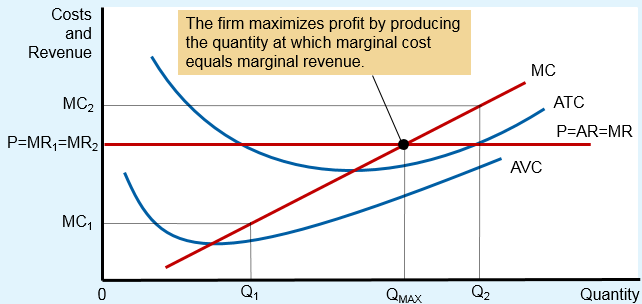
To maximize profit, a firm compares marginal revenue (MR) and marginal cost (MC):
If , increase production.
If , decrease production.
Profit is maximized where .
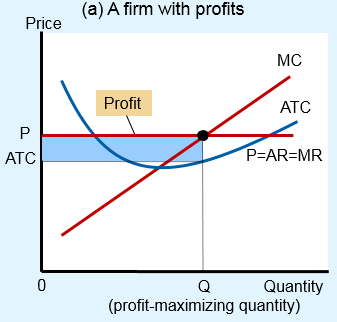
The intersection of the MC curve and the price line (which equals MR and AR in a competitive market) determines the profit-maximizing output.
Marginal Cost Curve as Supply Curve
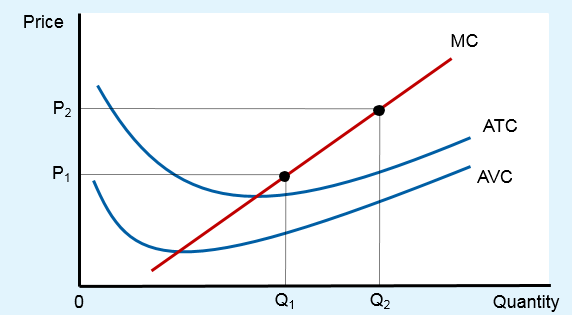
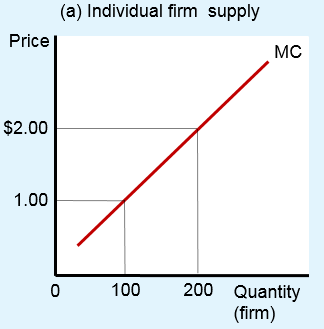
The marginal cost curve determines the quantity a firm is willing to supply at any price and acts as the firm's supply curve.
Short-Run and Long-Run Decisions
Shutdown and Exit Decisions
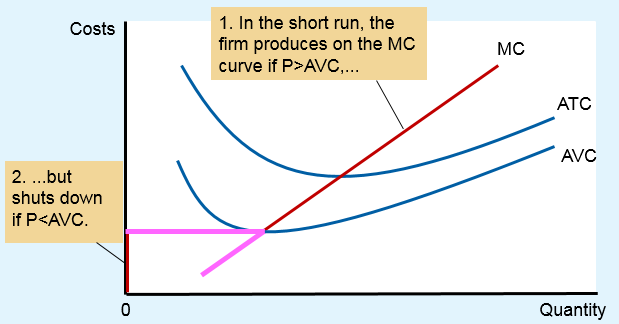
Shutdown: A short-run decision not to produce anything due to current market conditions. Fixed costs are still paid.
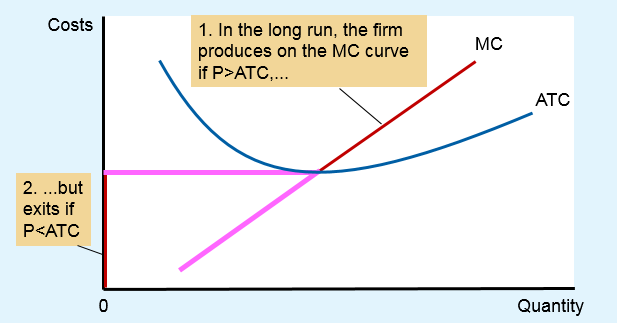
Exit: A long-run decision to leave the market entirely, avoiding all costs.
Short-Run Supply Curve
The firm's short-run supply curve is the portion of its MC curve above average variable cost (AVC). If price falls below AVC, the firm shuts down temporarily.
Long-Run Supply Curve
In the long run, the firm's supply curve is the portion of its MC curve above average total cost (ATC). If price falls below ATC, the firm exits the market.
Sunk Costs and Decision Making
Sunk Costs
Sunk costs are costs that have already been incurred and cannot be recovered. They should not influence current decisions. In the short run, fixed costs are considered sunk costs.
Application: Near-Empty Restaurants
Restaurants may stay open even with many empty tables if the revenue from lunch exceeds variable costs, ignoring fixed (sunk) costs.

Measuring Profit and Loss
Profit and Loss Calculations
If , Profit =
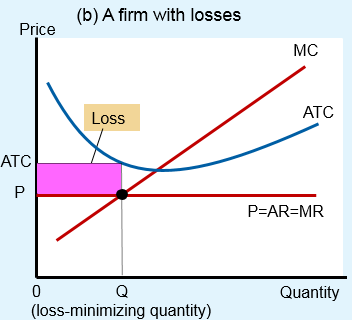
If , Loss =
Market Supply in Short Run and Long Run
Short-Run Market Supply
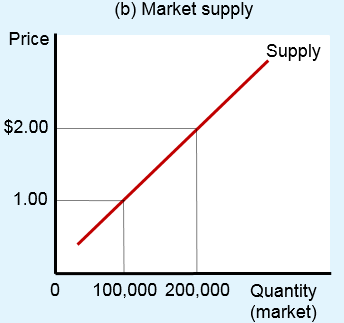
In the short run, the number of firms is fixed. The market supply curve is the sum of individual firms' MC curves above AVC.
Long-Run Market Supply
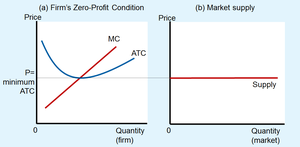
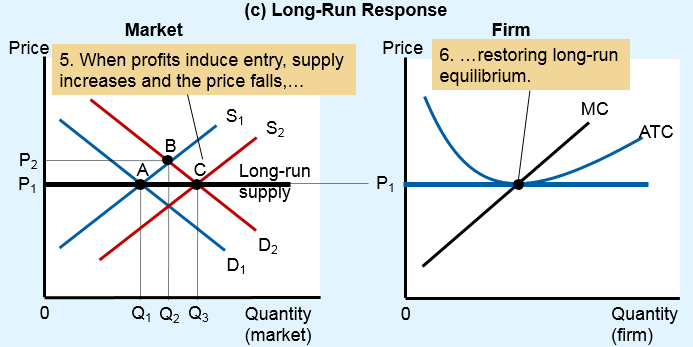
In the long run, firms can enter or exit the market. Entry and exit continue until economic profit is zero (), and the long-run supply curve is horizontal at the minimum ATC.
Economic vs. Accounting Profit
Zero-Profit Equilibrium
Even when economic profit is zero, accounting profit can be positive. Economic profit considers opportunity costs, while accounting profit does not.
Market Response to Changes in Demand
Short-Run and Long-Run Adjustments
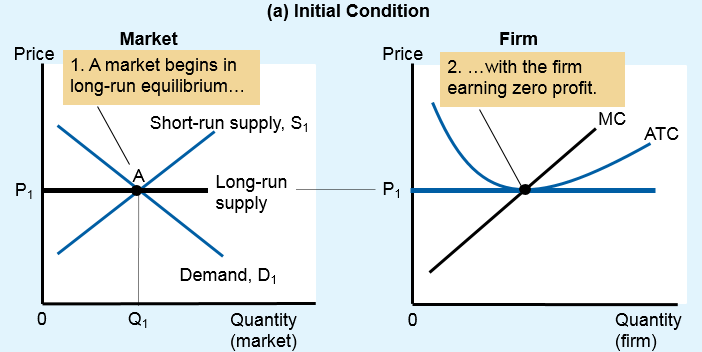
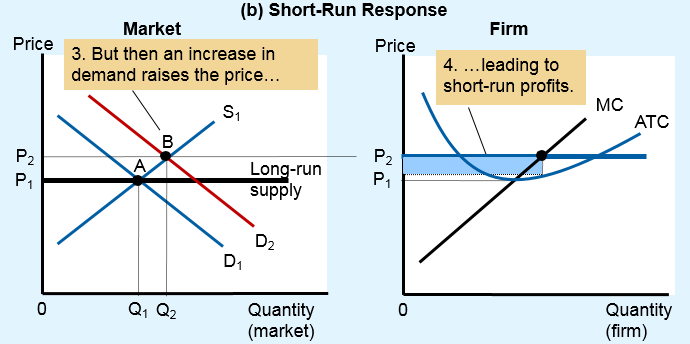
An increase in demand shifts the demand curve outward, raising price and quantity in the short run. Firms earn positive economic profit, encouraging entry. In the long run, supply increases, price returns to minimum ATC, and profits return to zero, but the market quantity is higher.
Elasticity of Supply Curves
Short-Run vs. Long-Run Supply Elasticity
Long-run supply curve is more elastic than the short-run supply curve.
If resources are limited or firms have different costs, the long-run supply curve may slope upward, and some firms may earn profit even in the long run.
