 Back
BackChap 12.2 - Firms in Perfectly Competitive Markets: Short-Run and Long-Run Decisions
Study Guide - Smart Notes
 Tailored notes based on your materials, expanded with key definitions, examples, and context.
Firms in Perfectly Competitive Markets
Introduction
Perfect competition is a foundational concept in microeconomics, describing a market structure where many firms sell identical products, and no single firm can influence the market price. This chapter explores how firms in perfectly competitive markets make production decisions in the short run and long run, and how these decisions affect market outcomes and efficiency.
Deciding Whether to Produce or Shut Down in the Short Run
Short-Run Production Decisions
When a firm in a perfectly competitive market is incurring losses, it faces two options: continue producing or temporarily shut down. The decision depends on the relationship between price, average variable cost (AVC), and fixed costs.
Continue to Produce: The firm produces if it can cover its variable costs, even if it cannot cover total costs (including fixed costs).
Shut Down: The firm shuts down if the market price is less than AVC, as it cannot cover its variable costs and would minimize losses by only paying fixed costs.
Key Rule: Produce if ; shut down if .
= Market price = Average variable cost
If the firm produces, it follows the marginal cost rule: produce the quantity where (for perfect competition, ).
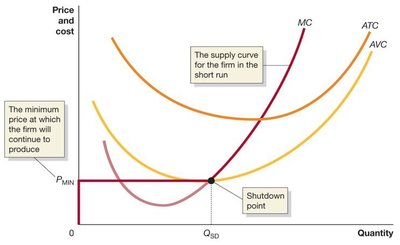
Additional info: The marginal cost (MC) curve above the minimum AVC is the firm's short-run supply curve.
Illustrating Profit or Loss on the Cost Curve Graph
Graphical Representation of Costs and Revenues
Cost curves help visualize a firm's profit or loss. The areas between price, average total cost (ATC), and quantity indicate total revenue, total cost, and profit or loss.
Total Revenue (TR): Area under the price line up to the quantity produced ().
Total Cost (TC): Area under the ATC curve up to the quantity produced ().
Variable Cost (VC): Area under the AVC curve up to the quantity produced ().
Loss: If ATC > P, the firm incurs a loss equal to .
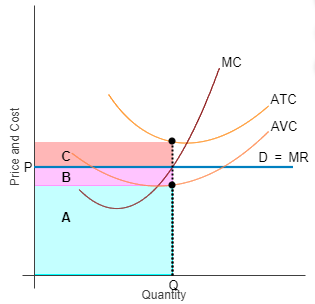
Application: Short-Run Profit and Shutdown Decisions
Example: Cost Curves and Market Price
Given a firm's cost curves and a market price, we can determine whether the firm should produce or shut down, and whether it earns a profit or incurs a loss.
If , the firm earns a profit.
If , the firm produces but incurs a loss.
If , the firm should shut down in the short run.
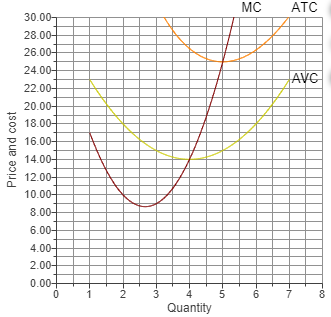
Example: Farmer Brown's Blueberry Farm
For Farmer Brown, the cost curves show the minimum prices needed to cover average total cost and average variable cost. Losses occur if the market price falls below ATC; shutdown occurs if price falls below AVC.
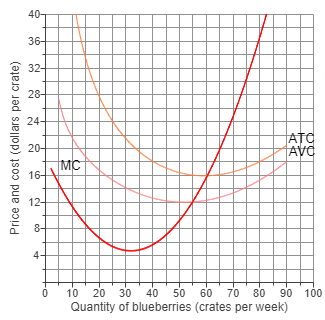
The Entry and Exit of Firms in the Long Run
Long-Run Adjustments
In the long run, firms can enter or exit the market. This process ensures that firms in perfectly competitive markets earn zero economic profit in the long run.
Entry: If firms are earning economic profit, new firms enter, increasing supply and driving down price until profits are eliminated.
Exit: If firms are incurring losses, some exit, reducing supply and driving up price until losses are eliminated.
The long-run equilibrium occurs where price equals the minimum point of the long-run average cost curve (LRAC), and firms break even (zero economic profit).
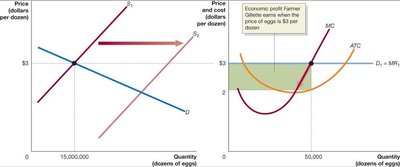
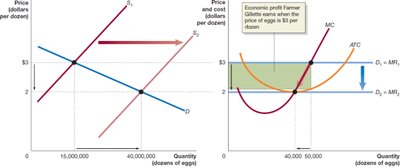
Graphical Illustration: Entry and Economic Profit
Entry of new firms shifts the market supply curve to the right, lowering the equilibrium price and reducing economic profit for existing firms.
Case Study: The Egg Market and Long-Run Equilibrium
Cage-Free Eggs and Market Dynamics
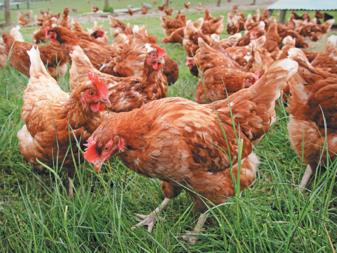
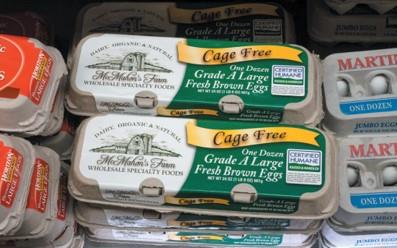
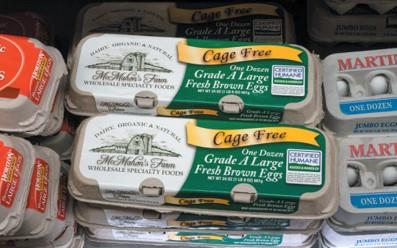
When demand for cage-free eggs increased, prices rose and farmers earned economic profits. However, as more farmers adopted cage-free methods, supply increased and prices fell, eliminating profits in the long run.
Additional info: This example illustrates how long-run entry and exit drive the market toward zero economic profit, even when new products or production methods are introduced.
Future Trends: Pasture-Raised Eggs
As new products like pasture-raised eggs command higher prices, economic profits attract new entrants, increasing supply and eventually reducing prices and profits.
Summary Table: Short-Run and Long-Run Decisions
Situation | Short-Run Decision | Long-Run Outcome |
|---|---|---|
Produce (Profit) | Entry of firms, price falls to | |
Produce (Loss) | Exit of firms, price rises to | |
Shut down | Exit of firms, price rises to |
Key Formulas
Total Revenue:
Total Cost:
Profit (or Loss):
Shutdown Rule: If , produce 0 units
Supply Curve: The portion of the MC curve above AVC
Conclusion
Perfectly competitive markets drive firms to produce efficiently and earn zero economic profit in the long run. Short-run decisions depend on the relationship between price and costs, while long-run entry and exit ensure that resources are allocated efficiently across the economy.
