 Back
Foundations of Economic Thought: Adam Smith, Karl Marx, and Capitalism
Study Guide - Smart Notes
 Tailored notes based on your materials, expanded with key definitions, examples, and context.
History of Economic Thought
Key Figures in Economics
This section introduces the foundational thinkers in economics, focusing on Adam Smith and Karl Marx, whose ideas shaped modern economic systems and philosophies.
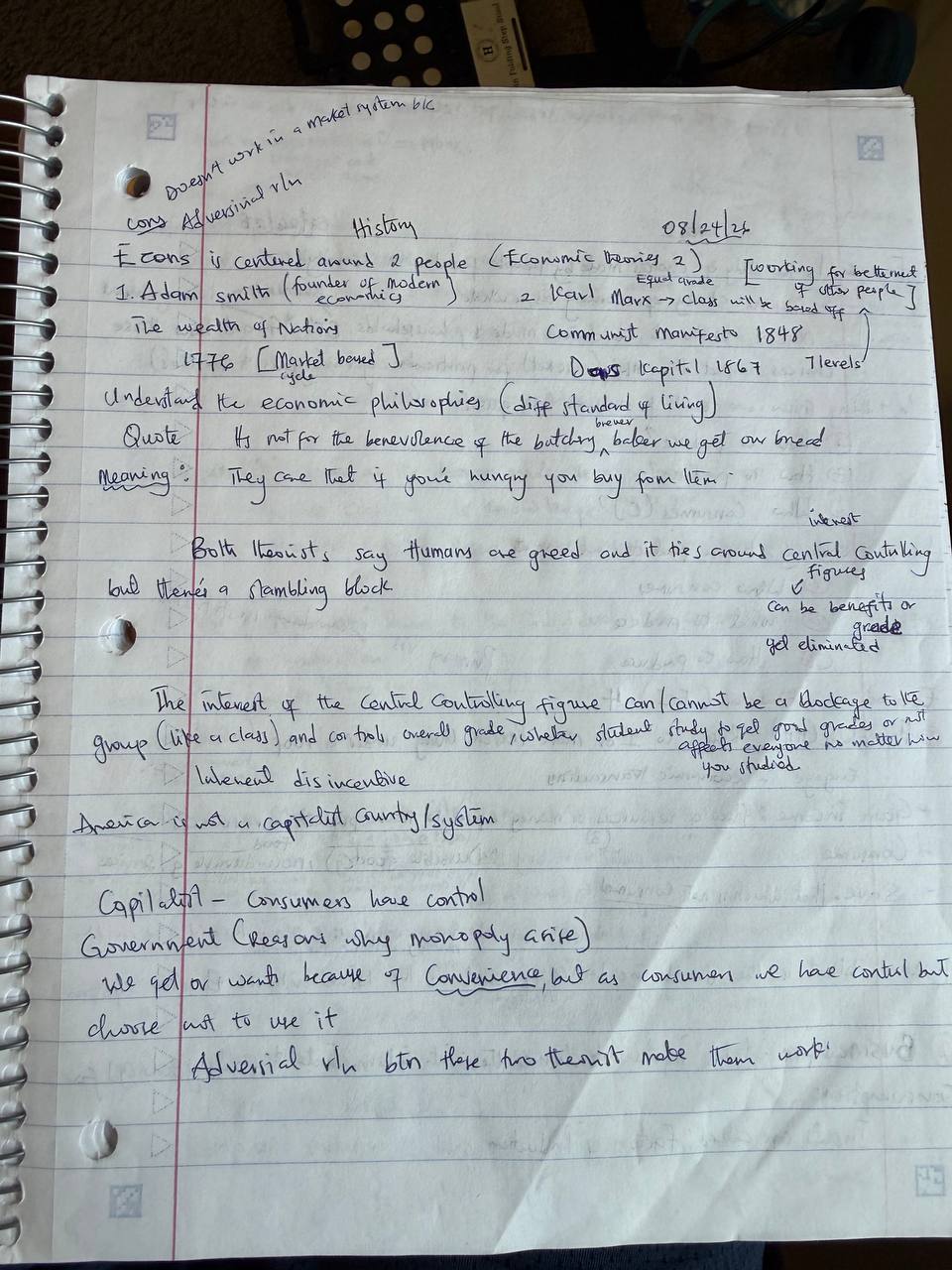
Adam Smith: Often regarded as the founder of modern economics. His seminal work, The Wealth of Nations (1776), introduced the concept of a market-based system.
Karl Marx: Known for his critique of capitalism and his work The Communist Manifesto (1848) and Das Kapital (1867), which discuss class struggle and economic control.
Example: Smith's market-based system emphasizes individual choice and incentives, while Marx's theories focus on class dynamics and central control.
Economic Philosophies and Incentives
Understanding the philosophies of Smith and Marx is crucial for grasping the principles of microeconomics, especially regarding incentives and the role of individuals versus central control.
Adam Smith's Quote: "It is not from the benevolence of the butcher, baker, or brewer that we expect our bread, but from their regard to their own interest."
Meaning: Individuals act out of self-interest, which drives economic activity and market efficiency.
Marx's Perspective: Central control can be a benefit or a drawback, depending on whether it diminishes incentives or addresses greed.
Example: If you are hungry, you buy food from those who supply it, not because they are generous, but because it is in their interest to sell.
Capitalism and Consumer Control
Market Systems and Consumer Choice
Capitalism is characterized by consumer control and market-driven decisions. The government may intervene, especially in cases of monopoly, but consumers ultimately have the power to choose.
Capitalism: Consumers have control over what is produced and consumed.
Government Intervention: Monopolies may arise due to convenience or lack of competition, but consumers can choose not to use monopolistic services.
Incentives: Incentives drive economic behavior, whether in capitalist or centrally controlled systems.
Example: We often use monopolistic services for convenience, but as consumers, we retain the choice to opt out.
Additional info: The notes reference the United States as not being a purely capitalist country/system, highlighting the role of government intervention and mixed economic structures.
Comparing Economic Systems
Market-Based vs. Centrally Controlled Systems
Economic systems can be classified based on who controls resources and decision-making: individuals (market-based) or central authorities (centrally controlled).
Market-Based System: Decisions are made by individuals and firms based on incentives and self-interest.
Centrally Controlled System: Decisions are made by a central authority, which can sometimes diminish individual incentives.
Example: In a market-based system, prices and production are determined by supply and demand. In a centrally controlled system, these are set by the government or a central figure.
Key Terms and Definitions
Incentive: A factor that motivates individuals to act in a certain way.
Monopoly: A market structure where a single firm controls the entire market.
Consumer Choice: The ability of consumers to decide what to purchase based on preferences and available options.
Relevant Equations and Concepts
Market Equilibrium
Market equilibrium occurs when supply equals demand, a fundamental concept in microeconomics.
Equation:
Where is quantity supplied and is quantity demanded.
Utility and Consumer Behavior
Utility theory explains how consumers make choices to maximize satisfaction.
Equation:
Where is utility and are goods consumed.
